Digging Through Music History to Identify Early Rock Recordings
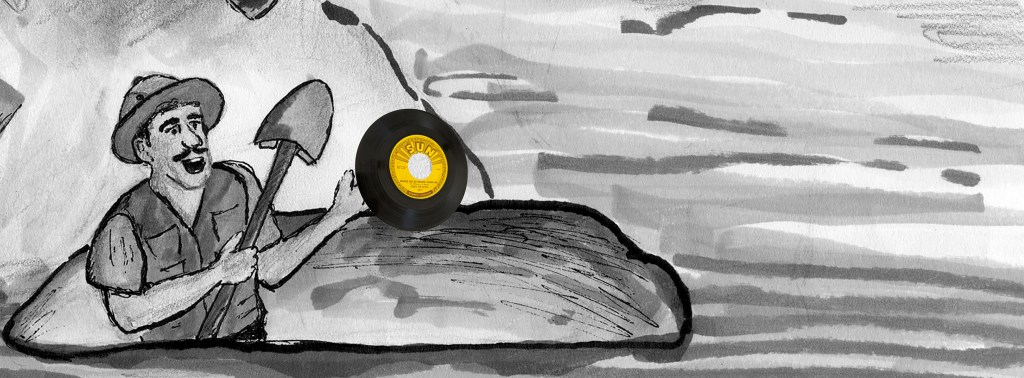
Since the beginning of time, humans have grappled with three existential questions: (1) what is the meaning of life; (2) what happens after death; and (3) what was the first rock and roll song. In this post, DIYRockAndRoll.com will answer definitively all three questions.
Just kidding. We’re not going to answer any of them, but we will shed some light on the third. There are several frequently cited contenders for first rock song, and plenty of other songs that probably should be considered. This post gathers select examples and offers arguments for and against their status as the first rock tune. Ultimately, what you view as the first rock song hinges on what you think rock is and where you think it evolved from.
Breaking Through to the Bedrock: Key Innovators on Rock’s Origins:
You may already have your own philosophy on rock’s origins. Here are some takes from a handful of key musicians who either recorded early rock, or recorded music that formed rock’s bedrock (pun intended). I also included a quote attributed to Alan Freed, the disc jockey often credited with “attaching the phrase ‘rock ‘n’ roll’ to the musical genre.”1 As some of the quotes below suggest, the music that we think of as rock and roll today may have been around for quite some time before the music industry labeled it as a distinct genre.
- Fats Domino in 1957: “What they call rock ‘n’ roll now is rhythm and blues . . . I’ve been playing it for fifteen years in New Orleans.”
- Muddy Waters in 1977: “Well the blues done had a baby and they named the baby rock and roll.”2
- Eddie Cochran in 1959: “I think [rock and roll has] been around for a long time but nobody’s actually recognized it. . . . . rhythm and blues and blues, you know, and blues has been around for so long. And then they kind of blended country and western music in with it.”
- Louis Jordan in 1973: “Rock ‘n’ roll was not a marriage of rhythm and blues and country and western. That’s white publicity. Rock ‘n’ roll was just a white imitation . . . [of] rhythm and blues.”3
- Little Richard in 1988: “I am the architect of rock and roll! . . . And I am the originator.”
- Jerry Lee Lewis in (?): “There was rockabilly. There was Elvis. But there was no pure rock’n’roll before Jerry Lee Lewis kicked in the door.”
- Alan Freed in (?): “Rock ’n roll is really swing with a modern name . . . It began on the levees and plantations, took in folk songs, and features blues and rhythm. It’s the rhythm that gets to the kids . . . they’re starved of music they can dance to, after all those years of crooners.”4
Select Contenders for the First Rock Song (in Approximate Chronological Order):
1944: Sister Rosetta Tharpe, Strange Things Happening Every Day
Arguments in favor of Strange Things Happening Every Day as first rock song: Here’s one of the earliest recordings that shows up on lists of the first rock songs.5 Sister Rosetta Tharpe’s impact on rock and roll is well-documented. Chuck Berry reportedly said that his career was “one long Sister Rosetta Tharpe impersonation.”6 Other sources describe Tharpe’s influence on figures including Jerry Lee Lewis and Sleepy LaBeef.7 Her stage showmanship was legendary, and by the 1960s Tharpe was rocking an iconic Gibson SG that exuded rock and roll.8 This 1944 recording features an energetic boogie woogie beat, call-and-response vocal choruses, and Tharpe’s powerful singing and nimble guitar.
Arguments against Strange Things Happening Every Day as first rock song: Strange Things Happening Every Day is a commanding performance by a true innovator. When you listen to it, you can hear many of the ingredients that would become key components of rock and roll. But to modern ears, Strange Things may not really sound like rock. Some of that may be technological. Tharpe was an early adopter of the electric guitar,9 and I have read that she is playing an electric on Strange Things. But before reading that, I assumed it was an acoustic resonator guitar given the punchy sound and limited sustain. To my ears, the basic sonority of the song is not too far removed from some 1930s blues tracks. Strange Thing‘s boogie feel can also be traced back to earlier recordings. Similarly, if Strange Things is rock and roll, it might be tricky to explain why some earlier recordings by Louis Jordan aren’t as well. For those who consider lyrics among their criteria, the religious focus of Strange Things may also make it a tough sell as the first rock song.
1946/1947ish: Amos Milburn, Down the Road Apiece
Arguments in favor of Down the Road Apiece as first rock song: This song is a bit of a wild card for consideration, but between its rollicking piano, quick tempo, and celebratory lyrics about hard-driving music, it really does have some ingredients that make it stand out from other R&B of its vintage. When Chuck Berry and the Rolling Stones later covered the song, they didn’t have to do a heck of a lot to modernize it. To me, Milburn’s left hand piano work sounds like straight rock and roll, and foreshadows Jerry Lee Lewis’ playing about a decade later.
Arguments against Down the Road Apiece as first rock song: Down the Road Apiece is a boogie-woogie R&B song. Milburn’s left hand may have been rocking in a way that sounds ahead of its time, but the rest of the track leans towards jazz. That includes the percussion, Milburn’s vocal phrasing, and some of his right hand embellishments. One other issue is that some of what makes this track so rocking can be found in boogie woogie songs going all the way back to the 1930s.10
1947: Roy Brown, Good Rocking Tonight
Arguments in favor of Good Rocking Tonight as first rock song: Good Rocking Tonight is A classic piece of New Orleans R&B. It’s also a tantalizing choice for first rock recording if you agree with Fats Domino’s view that rock and roll had existed as New Orleans R&B for years before anyone called it rock. Roy Brown wrote this eventual rock standard, which went on to be covered by Wynonie Harris (see below), Elvis Presley, and Jerry Lee Lewis. It’s got a great beat and impassioned singing. Bonus points: Good Rocking also features the word “rocking” in the title and the lyrics! (For what it’s worth, Brown reportedly performed live with a great deal of rock and roll flash11).
Arguments against Good Rocking Tonight as first rock song: Instrumentally and stylistically, it may not be enough of a departure from other phenomenal 1940s New Orleans R&B.
1948: Wynonie Harris, Good Rockin’ Tonight
Arguments in favor of Good Rockin’ Tonight as first rock song: No you’re not seeing double. In 1948, Wynonie Harris covered Roy Brown’s Good Rocking Tonight. According to some accounts, Brown only recorded the song after pitching it unsuccessfully to Harris.12 The two versions are very similar in many respects, but Harris’ version has a more obvious backbeat emphasized with handclaps. It also loses some of the jazzier sounding horn embellishments.
Arguments against Good Rockin’ Tonight as first rock song: This is a particularly defensible pick for the first rock song, but I suspect one argument against it would be that Harris’ rendition isn’t all that different from Brown’s earlier recording. And although Harris’ has the heavier beat, I’d probably have to give Brown’s the edge for sheer vocal intensity and drama.
1948: Wild Bill Moore, Rock and Roll
Arguments in favor of Rock and Roll as first rock song: The title! Also, it’s got a great backbeat, impassioned vocals, and call-and-response vocal choruses.
Arguments against Rock and Roll as first rock song: Besides the title, singing, and beat, it’s jazzy R&B all-the-way. Rock and Roll is a horn driven track that sounds like some other great jump blues recordings from the 1940s.
1949: Fats Domino, The Fat Man
Arguments in favor of The Fat Man as first rock song: The Fat Man might be the ultimate pick if you agree with Fats Domino’s 1957 statement that rock and roll had existed as New Orleans R&B for years before anyone recognized it as a distinct genre. Listen to that pounding piano and heavy beat! The Fat Man also features the kind of innuendo and boasting that rock listeners will surely find familiar. The Fat Man is also not too far off sonically from the music that Fats was recording in the 1950s, which I think most would agree is rock.
Arguments against The Fat Man as first rock song: The truth is, I’ll never argue very hard against someone who thinks The Fat Man is the first rock song. It’s a tremendous record by one of my all time favorites. The reason I don’t think of it as the first rocker can also be traced to Domino’s statement that rock had existed as New Orleans R&B since at least the mid 1940s. If The Fat Man is rock, I personally find it difficult to explain why other New Orleans discs from the 1940s aren’t. (See, for example, Roy Brown’s Good Rocking Tonight, above). Similarly, you’d have to explain why the earlier output of Amos Milburn (an influence on Domino) isn’t rock if The Fat Man is.
1949: Jimmy Preston, Rock the Joint
Arguments in favor of Rock the Joint as first rock song: Well, to begin with, there’s the title! Rocking the joint is clearly Jimmy Preston’s mission statement in this fiery performance from the late 1940s. The song’s boogie beat is particularly heavy. Rock the Joint also has impassioned vocals, call-and-response vocal choruses, and honking saxophone. Those ingredients combine in moments of near-anarchy that feel very rock and roll.
Arguments against Rock the Joint as first rock song: At its core, the song is built around a boogie-woogie riff that is structurally similar to earlier jump blues recordings by artists like Louis Jordan.13 Wynonie Harris’ Good Rockin’ Tonight also has a heavy backbeat and came first. Further, the sonic ingredients of Rock the Joint are straight R&B/jump blues, given the emphasis of piano and saxophone over electric guitar.
1949: Louis Jordan and His Tympany Five, Saturday Night Fish Fry
Arguments in favor of Saturday Night Fish Fry as first rock song: Truth be told, there are a lot of Louis Jordan songs that could probably go on this list.14 As I’ve discussed in previous posts, Jordan’s innovative brand of jump blues was an enormous influence on R&B and rock. This recording merits particular attention because of its blend of uptempo boogie-woogie beat, recurring electric guitar riff, and call-and-response vocal choruses. It also doesn’t hurt its credentials that the lyrics are about a party so rocking that it draws the fuzz!
Arguments against Saturday Night Fish Fry as first rock song: The main argument against Saturday Night Fish Fry is probably that it sounds so jazzy. Although Fish Fry has elements that prefigure rock and roll, to modern ears it may sound a bit more like swing, particularly with its its occasional horn embellishments and emphasis on piano. There is electric guitar, but it does not get a solo and is certainly not as boisterous as on later tracks like Rocket 88 and Love My Baby.
1951: Jackie Brenston and his Delta Cats (AKA Ike Turner and His Kings of Rhythm), Rocket 88
Arguments in favor of Rocket 88 as first rock song: Well, here we’ve got a big one! Rocket 88 is the record probably most-cited as the first rock recording.15 Although released on the Chicago label Chess,16 Rocket 88 was actually recorded in Sam Phillips’ Memphis studio not long before he launched Sun Records (arguably the most consequential label in rock history).17 The vocals are by Jackie Brenston, but it’s really Ike Turner’s band.18
So why has Rocket 88 earned the first rocker superlative from so many? Part of it has to be Willie Kizart’s “fuzz toned” guitar, which itself is the stuff of rock legend.19 According to many accounts, during the band’s drive “up Highway 61 to make the record in Memphis,” Kizart’s guitar “amplifier fell out of the trunk, and Sam Phillips . . . stuffed the amp’s broken speaker cone with brown wrapping paper in the studio.”20 One music historian wrote that the sound is “consistent with a sliced speaker cone,” but Ike Turner insisted that the amp was damaged when rainwater seeped into the car’s trunk.21 Either way, for many it’s the fuzzy guitar that “pushed ‘Rocket ‘88’ into rock and roll territory.”22 Of course, the song’s subject matter is about as rock and roll as it gets. If you take the lyrics at face value, they are about a vehicle: the Oldsmobile Rocket 88. But at another level, the automotive lyrics are a vehicle . . . for sexual innuendo.23 In addition, The youthful exuberance that permeates Rocket 88 foreshadows so many of the young artists and bands that would help define rock and roll in the coming years.24 Further, Rocket 88 was a number one R&B hit and therefore quite influential.25According to author Ian S. Port, Rocket 88 inspired Bill Haley to “change his entire direction, switching from Bob Wills-style western swing to rhythm and blues.”26
Arguments against Rocket 88 as first rock song: Gosh, well I’ve almost convinced myself that Rocket 88 is the first rock recording. Rocket 88 is a historically important recording and a ton of fun. The reason that I’ve long been reluctant to commit to the song as the first rocker is similar to my reasoning for other tracks above. That is, I’m still not sure that when I hear Rocket 88, I’m not just hearing a killer R&B song. In that vain, in some respects I think Fats Domino’s The Fat Man and Jimmy Preston’s Rock the Joint actually hit just a little bit harder. Maybe the distorted guitar is enough to differentiate Rocket 88, but I’m just not sure. Another argument against Rocket 88 as the first rock song might be its origins: Rocket 88 is a reworking of the 1947 recording Cadillac Boogie by Joe Liggins. Rocket 88 is certainly harder-edged than Cadillac Boogie, but is it enough of a departure to mark the launch of rock and roll?
1952: Bill Haley With The Saddlemen, Rock the Joint
Arguments in favor of Rock the Joint as first rock song: No, you’re not having deja vu! This is the same Rock the Joint song discussed above. But this time it is a recording by a white musician with a country and western background rather than a black musician with an R&B background. Bill Haley’s version of Rock the Joint is probably a tantalizing choice for first rock song among those who subscribe to the view that rock grew out of a blend of R&B/blues with country and western. Haley is clearly merging his western swing roots with R&B material.
Arguments against Rock the Joint as first rock song: Although there are moments that sound pretty rock and roll (like the frenetic electric guitar solo starting around the 33 second mark), a lot of the arrangement sounds like a holdover from Western swing (like the tinkly piano solo around the one minute mark). As a result, the recording sometimes sounds less like the alchemy of R&B and country into a new genre, and more like a countrified cover of an R&B song. Plus, Preston’s 1949 version already contained so many of the ingredients that make the Haley cover rock.
1952: Willie Mae “Big Mama” Thornton, Hound Dog
Arguments in favor of Hound Dog as first rock song: Ooooh, we are right on the cusp of rock and roll with this one! Most are likely familiar with Elvis Presley’s mega-hit version of this song.27 I suspect many are also aware that it’s a cover of this recording by Big Mama Thornton. Perhaps slightly less well-known, Hound Dog was penned by “Jerry Leiber and Mike Stoller, two white song writers who loved black music”.28 The song seems to have taken on a life of its own in discourse over musical borrowing, innovation, and misappropriation. For anyone interested in reading about the song’s fascinating history, I highly recommend Theft!, a History of Music by James Boyle, and Jennifer Jenkins.29 Anyway, putting aside Hound Dog‘s background, it has a lot going for it as a potential first rock song. Most importantly, there’s Thornton’s powerful vocal. There’s also the incessant electric guitar riff played over a strong beat. And then there’s Hound Dog‘s unquestionable influence (Thornton’s version was a big chart hit30).
Arguments against Hound Dog as first rock song: Like many (all?) of the songs on this list, I won’t put up much of a fight if you think this is the first rock record. It’s phenomenal. The main argument against this as the first rock song would probably be that Rocket 88 contains similar attributes and was recorded earlier. Another might be that despite having some obvious rock qualities, Hound Dog at its core still sounds a bit more like blues or R&B. Sonically, the electric guitar isn’t quite as raucous as on Rocket 88 (above) or Love My Baby (below).
1953: Bill Haley & His Comets, Crazy Man, Crazy
Arguments in favor of Crazy Man, Crazy as first rock song: Okay, Bill Haley is back with a fun record and another contender! I think the arguments here are very similar to the ones above for his version of Rock the Joint. Crazy Man, Crazy abandons some of Rock the Joint’s more obvious western swing holdovers. The electric guitar is more dominant. The beat is a little bit more pronounced. There are call-and-response vocal choruses. The screaming right before the guitar solo would become a hallmark of rockabilly (particularly the work of Gene Vincent).
Arguments against Crazy Man, Crazy as first rock song: These are also probably similar to the arguments against Haley’s version of Rock the Joint being the first rock recording, even though Haley shed much of the overt Western swing sound on Crazy Man, Crazy. I think it’s completely defensible to call this a rock record, but if you do, I think some of the earlier contenders, like Hound Dog, Rocket 88, and The Fat Man, are too. Arguably, those songs are a bit more raucous, particularly Rocket 88 with its unhinged guitar tone. Despite its title, which announces craziness, some might argue that Crazy Man, Crazy is still just a tad polite and restrained for rock and roll.
1953: Big Joe Turner, Honey Hush
Arguments in favor of Honey Hush as first rock song: What good is a list of possible first rock tunes if it doesn’t feature Big Joe Turner? This 1953 track boasts powerful singing, call-and-response vocals, a quick tempo, and a great backbeat. The song also sounds like Shake Rattle, and Roll (1954), which itself has been described as one of the “cornerstone[] numbers of the rock and roll revolution.”31
Arguments against Honey Hush as first rock song: Big Joe Turner was a blues shouter extraordinaire who came out of the Kansas City jazz and blues scene.32 Backed by pianists like Pete Johnson, Turner had been recording boogie woogie material since the 1930s.33 One possible argument against Honey Hush as the first rock song might actually be that earlier material. Is Honey Hush enough of a departure from Turner’s earlier recordings to demarcate a new genre, given that it remains pretty boogie-woogie centric in its own right? Or might Turner’s earlier works also be rock?34 Relatedly, much of what might make Honey Hush a rock song is arguably contained in some of the earlier contenders above–particularly the Wynonie Harris version of Good Rockin’ Tonight. Finally, the instrumentation of Honey Hush is arguably a holdover from 1940s R&B/jump blues. Other than a brief electric guitar line at the outro, Honey Hush basically features piano and saxophone all the way.
1953: Little Junior’s Blue Flames (AKA Little Junior Parker and His Blue Flames), Love my Baby
Arguments in favor of Love My Baby as first rock song: We’re back at Sun Records for this one! Like so many of the best rock recordings, Love My Baby is turbocharged blues. If you agree with the Muddy Waters’ philosophy that rock and roll is just a “baby” of the blues, I don’t know if you could pick a better contender for the first rock recording than Love My Baby. Parker’s Love My Baby could also be a good contender for first rock track if you believe Eddie Cochran’s philosophy that rock grew out of blues and R&B with some eventual cross-pollination from country and western. That’s because, as I’ve discussed previously, Love My Baby has a hint of a country feel that makes the track sound like rockabilly.
What’s special about Love My Baby? First, there’s the blistering electric guitar. Depending on the source, the guitarist is either Floyd Murphy or Pat Hare.35 Regardless, the heavily overdriven guitar riffs are ahead of their time. Second, I think there’s an argument that Little Junior Parker’s vocal phrasing is itself part of the rock lexicon, given its probable influence on label mate Elvis Presley (who would soon record a version of Parker’s composition Mystery Train). Third, the song has a quick tempo and steady backbeat. Fourth, the lyrics are dripping with innuendo.
Arguments against Love My Baby as first rock song: In the effort of transparency, the DIYRockAndRoll.com Office of the Ombudsman has asked me to note that I’ve been arguing for years that Love My Baby is the first rock song. With that caveat, here are my straw man counterarguments against Love My Baby as first rock track. First, Love My Baby might be too bluesy. Second, Parker’s singing might be too smooth. (Intriguingly, I have read that Parker preferred more urbane material and didn’t think much of some of the more raucous tracks he recorded at Sun36). Finally, Rocket 88 featured overdriven guitar before Love My Baby.
Honorable Mentions and Milestones:
1938/39ish: Pete Johnson & Big Joe Turner, It’s All Right Baby
Relections on It’s All Right Baby: In a previous post, I described an interview between country musician Johnny Bond and early rocker Eddie Cochran. In their discussion of rock’s origins, Bond suggested that rock and roll used to be called boogie woogie. If any recording supports that argument, it has to be It’s All Right Baby performed by Pete Johnson and Big Joe Turner at the legendary “From Spirituals to Swing” concerts of 1938/1939. Johnson’s piano prefigures that of Jerry Lee Lewis, and Turner’s vocals are much the same as they would be on his 1950s classics like Shake, Rattle and Roll (covered by Elvis). I’m including It’s All Right Baby as an honorable mention rather than a genuine contender for two reasons. First, there’s no percussion. If it had percussion, I bet it would sound a heck of a lot like Honey Hush, which I did include above. Second, if you consider something this old rock and roll, it really blows the whole thing up doesn’t it? Or does it?
1946: Louis Jordan and His Tympany Five, Choo Choo Ch’Boogie
Reflections on Choo Choo Ch’Boogie: This one predates Saturday Night Fish Fry (discussed above) by several years. It illustrates how many of the eventual ingredients of rock and roll were already integral to Jordan’s music by the mid 1940s. Those attributes included strong tempos and beats, playful lyrics, and catchy choruses. In many respects, Choo Choo is very similar to Saturday Night Fish Fry. I am treating Fish Fry as an honorable mention rather than a contender because its instrumentation and musical palette register much more as jump blues than rock. If Choo Choo had the electric guitar of Fish Fry, I probably would have included it above.
1948: John Lee Hooker, Boogie Chillen’
Reflections on Boogie Chillen‘: John Lee Hooker’s minimalist Boogie Chillen’ is simultaneously an innovation and a throwback to earlier blues. It’s hard to imagine rock and roll without John Lee Hooker’s influence, particularly the iconic riff in Boogie Chillen’. Some of Little Junior Parker’s seminal recordings for Sun Records were reportedly an attempt to cash in on the John Lee Hooker boogie sound.37 Later permutations of the Boogie Chillen‘ riff have underpinned rock tracks for decades, including Norman Greenbaum’s Spirit in the Sky, ZZ Top’s La Grange, and Tom Petty’s Saving Grace.
1951, B.B. King, She’s Dynamite
Reflections on She’s Dynamite: As the title suggests, this is one explosive track from B.B. King. A reworking of a song by Tampa Red,38 She’s Dynamite sports a heavy backbeat, distorted guitar, powerful vocals, and plenty of innuendo. The reason I’m listing it as an honorable mention rather than a contender for first rocker, is that it was recorded a few months after Rocket 88 (which shared the same ingredients).39 She’s Dynamite came out of Sam Phillips’ studio, so at the very least it provides additional evidence that Memphis was at the epicenter of rock’s big bang.
When B.B. King shows up in rock histories, the focus is generally on his influential guitar playing. So it’s a bit ironic that on this track–arguably one of the earliest rock recordings–B.B. King is likely not actually playing! According to Colin Escott, “The guitarist [on She’s Dynamite] was certainly not B.B. because he plays under the vocals…. something B.B. never did. We’re probably hearing Calvin Newborn on his guitar and his brother, Phineas, on piano.”40
1952, The Radio Four (AKA The Gospel Five), My Trouble is Hard
Reflections on My Trouble is Hard: This one is so obscure I can’t even find it on Youtube or Spotify! I heard it on an out-of-print CD called “The Radio Four, 1952-1954.” According to the liner notes, the Radio Four was a gospel group consisting of a family of corn and tobacco farmers from Logan County, Kentucky. In general, gospel music probably does not get enough credit as one of the key ingredients of rock and roll. The genre’s influence on rock can be inferred from the legendary Million Dollar Quartet sessions–a spontaneous jam at Sun Records studios by Elvis Presley, Carl Perkins, Jerry Lee Lewis, and Johnny Cash. Much of the material they pulled out was gospel, because that was what each of those musicians had in common and knew by heart. Anyway, back to My Trouble is Hard: it’s certainly not rock and roll, but the rhythm section on that song sounds so much like the rockabilly hits that would be coming out of Sun Records within months. (Credit on “discovering” this lost gem goes to my cousin Ian, a true music lover).
1953, Big Bill Broonzy, Little City Woman
Reflections on Little City Woman: When rock and roll began, it must have felt not only like music for the young, but also by the young. Elvis, Eddie Cochran, Gene Vincent, Buddy Holly, and Bo Diddley were all in their teens or twenties when they had their first hits. That narrative is complicated a bit by influential artists like Big Joe Turner (Turner was well over a decade into his career by the time he hit big with Shake, Rattle and Roll in 1954). But the narrative is nearly annihilated if you account for Big Bill Broonzy. Broonzy was born in the 1800s (at least by some accounts),41 and his recording career began in the 1920s. Most of his phenomenal catalog consists of acoustic blues. On the 1953 session that generated Little City Woman, Broonzy is joined by Ernest “Big” Crawford (bass), Washboard Sam (washboard, obviously), and Lee Cooper (guitar).42 The resulting sound reminds me of the earliest Elvis recordings featuring Bill Black and Scotty Moore.43 The slightly overdriven electric guitar part, which is either Broonzy or Lee Cooper, also approaches rock territory.44 It’s interesting to hear how close Broonzy got to recording one of the earliest rock songs, given that he might have been born in the previous century. Either way, it’s a great listen.
1958, Link Wray & The Wraymen, Rumble
Reflections on Rumble: Rock and roll existed long before Rumble came into the world. I’m including Rumble because I think it’s the song that pushed the genre from rock and roll to ROCK. There are some excellent accounts of the influence of Rumble.45 But just listen to that guitar distortion, famously derived by Wray poking holes in his amp’s tweeters with a pen.46
Conclusion:
Writing this article was an absolute blast. What could be better than listening to some of the most boisterous and innovative recordings in music history? I appreciate all of these songs and found it much easier to argue for their status as first rock track, than against it.
Think of this less as a static list, and more of a live document that I will update as I learn of additional contenders. On that note, I would love to hear from you! Let me know in the comments which of these songs you think is the first rock and roll recording! And if you think there’s one I missed (I’m sure there is) I’d be curious about that too.
- https://ultimateclassicrock.com/alan-freed-dies/ ↩︎
- To be fair, this is a lyric from a song Waters co-wrote with Brownie McGhee: The Blues Had a Baby and They Named It Rock and Roll, Pt. 2, from the 1977 album Hard Again. ↩︎
- This quote comes from a 1973 interview between Louis Jordan and Arnold Shaw, included in Shaw’s seminal treatise on early R&B entitled Honkers And Shouters: The Golden Years of Rhythm and Blues. ↩︎
- https://ultimateclassicrock.com/alan-freed-dies/ ↩︎
- E.g., https://www.theguardian.com/music/2011/jun/12/rock-n-roll-record; https://www.saturdayeveningpost.com/2021/03/the-very-first-rock-and-roll-song/ ↩︎
- https://www.udiscovermusic.com/stories/sister-rosetta-tharpe-rocknroll-pioneer/ ↩︎
- https://www.britannica.com/biography/Sister-Rosetta-Tharpe#ref1313704 ↩︎
- https://www.guitarworld.com/features/sister-rosetta-tharpe-electric-guitar-trailblazer ↩︎
- https://www.guitarworld.com/features/sister-rosetta-tharpe-electric-guitar-trailblazer ↩︎
- See discussion of It’s Allright, Baby, infra. ↩︎
- https://www.nytimes.com/1981/05/26/obituaries/roy-brown-a-pioneer-rock-singer.html#:~:text=His%20flashy%20stage%20clothes%2C%20uninhibited%20performances%2C%20and%20driving%20music%20made%20him%20one%20of%20the%20pioneers%20of%20rock%2Dand%2Droll. ↩︎
- https://www.spontaneouslunacy.net/wynonie-harris-good-rockin-tonight-king-4210/ ↩︎
- See discussion of Choo Choo Ch’Boogie, infra. ↩︎
- Again, I implore you, see discussion of Choo Choo Ch’Boogie, infra. ↩︎
- Not that I have the statistics to back that up. But see, e.g., Holly George-Warren and Patricia Romanowski, The Rolling Stone Encyclopedia of Rock & Roll (3d. ed.) at
1009 (“It became a #1 R&B hit, and over the years it has been frequently cited as the first rock & roll record.”); https://msbluestrail.org/blues-trail-markers/rocket-88 (“[M]any historians opine that the distorted buzz in the guitar sound and the song’s raw, youthful energy and driving boogie rhythm qualified it as the first example of rock ‘n’ roll.”) https://www.motortrend.com/vehicle-genres/oldsmobile-rocket-88-first-rock-n-roll-song-history ↩︎ - In the early 1950s, Chess was likely best known for blues releases like those of Muddy Waters, but within a few years, Chess would be releasing essential rock tracks by Bo Diddley and Chuck Berry. ↩︎
- https://sunrecords.com/history/. ↩︎
- https://www.udiscovermusic.com/stories/the-first-rock-n-roll-record/ ↩︎
- See Colin Escott, Jackie Brenston & His Delta Cats – Rocket 88, an essay included in the liner notes to Bear Family’s essential The Sun Blues Box, available at https://www.bear-family.com/various-sun-records-sun-blues-box-1950-1958-10-cd-deluxe-box-set.html?srsltid=AfmBOorOr8-AHEWAZ2oDvmQ5JLIZt4BXWCKjMGH1dcYJU_klDjFRThi5 (providing historical discussion of Rocket 88 including the guitar tone). ↩︎
- https://msbluestrail.org/blues-trail-markers/rocket-88; see also https://www.loc.gov/static/programs/national-recording-preservation-board/documents/Rocket-88_Propes.pdf (similar). ↩︎
- Supra, Escott. ↩︎
- https://www.loc.gov/static/programs/national-recording-preservation-board/documents/Rocket-88_Propes.pdf ↩︎
- See https://www.theguardian.com/music/2011/jun/12/rock-n-roll-record (“A bawdy swing/blues concoction with a raunchy sax break, it hymned a particular model of Oldsmobile and threw sexual innuendo into the mix with lines such as ‘Everybody likes my Rocket 88/Baby, we’ll ride in style’. Where would a million future garage bands have been without it?”); see also Ian S. Port, The Birth of Loud at 101 (describing Rocket 88 as “a song about sexual power”). ↩︎
- According to Escott, Brenston was underage during the session “and the contract had to be signed by his mother.” Supra, Escott. According to another source, the entire band was between 17 and 20 years of age. https://msbluestrail.org/blues-trail-markers/rocket-88 ↩︎
- George-Warren and Romanowski, Supra. ↩︎
- Port, supra, at 103. ↩︎
- One history of the song may be found here: https://www.loc.gov/static/programs/national-recording-preservation-board/documents/HoundDog.pdf ↩︎
- See “Theft! A History of Music” by James Boyle, Jennifer Jenkins, Keith Aoki, at 142 (2017). ↩︎
- Id. The book is available for free here under a Creative Commons license. https://web.law.duke.edu/musiccomic/read/frontcover/. I am biased, because I had the immense honor of assisting with some fact checking in the book and am listed in the acknowledgements haha! ↩︎
- https://www.songsthatsavedyou.com/p/hound-dog-big-mama-thornton ↩︎
- https://www.rhino.com/article/big-joe-turner ↩︎
- Id. ↩︎
- See discussion of It’s Alright Baby, infra. ↩︎
- Id. ↩︎
- Escott and Davis; id., say it’s Murphy. Other articles say Hare. See https://ig.ft.com/life-of-a-song/mystery-train.html#:~:text=Turner%20had%20failed,Blue%20Flames)%20—%C2%A0didn’t. It really sounds like Pat Hare to me, given the overdriven tone. ↩︎
- https://www.toppermost.co.uk/parker-junior/#:~:text=4.-,According%20to%20Black%20Cat,I%20rather%20like%20i,-t (“Junior saw himself as a sophisticated, uptown blues singer but at his audition with Sam Phillips at Sun, that didn’t go down too well and Phillips asked him for something rougher ‘like John Lee Hooker’s Boogie Chillen‘. Parker and the band reportedly knocked up a parody of said song on the spot, and that’s how Feelin’ Good was born.”). ↩︎
- https://www.toppermost.co.uk/parker-junior/#:~:text=4.-,According%20to%20Black%20Cat,I%20rather%20like%20i,-t ↩︎
- See Colin Escott, B.B. King – She’s Dynamite, an essay included in the liner notes to Bear Family’s essential The Sun Blues Box. ↩︎
- Id. ↩︎
- Id. ↩︎
- See Studs Terkel, Liner Notes, Big Bill Broonzy and Washboard Sam, Chess Records (MCA) 1986 (stating date of birth as June 26, 1883). Other sources list his birth year as 1893 and 1903. ↩︎
- Id. ↩︎
- Id. ↩︎
- Id. ↩︎
- https://www.loc.gov/static/programs/national-recording-preservation-board/documents/RUMBLE-FINAL.pdf ↩︎
- Id. ↩︎
 DIY Rock and Roll