Why review a current production guitar when you can give the people what they really want? That is, a review of a relatively-obscure electric guitar that has been largely out-of-production for over a half-century. Well, if you’re in the infinitesimally small group of people who have their eyes on a vintage Fender Coronado rather than a Stratocaster, Telecaster, Jazzmaster, Jaguar, Les Paul, ES-330/335, Firebird, SG, Gretsch, or Rickenbacker, this review is for you.
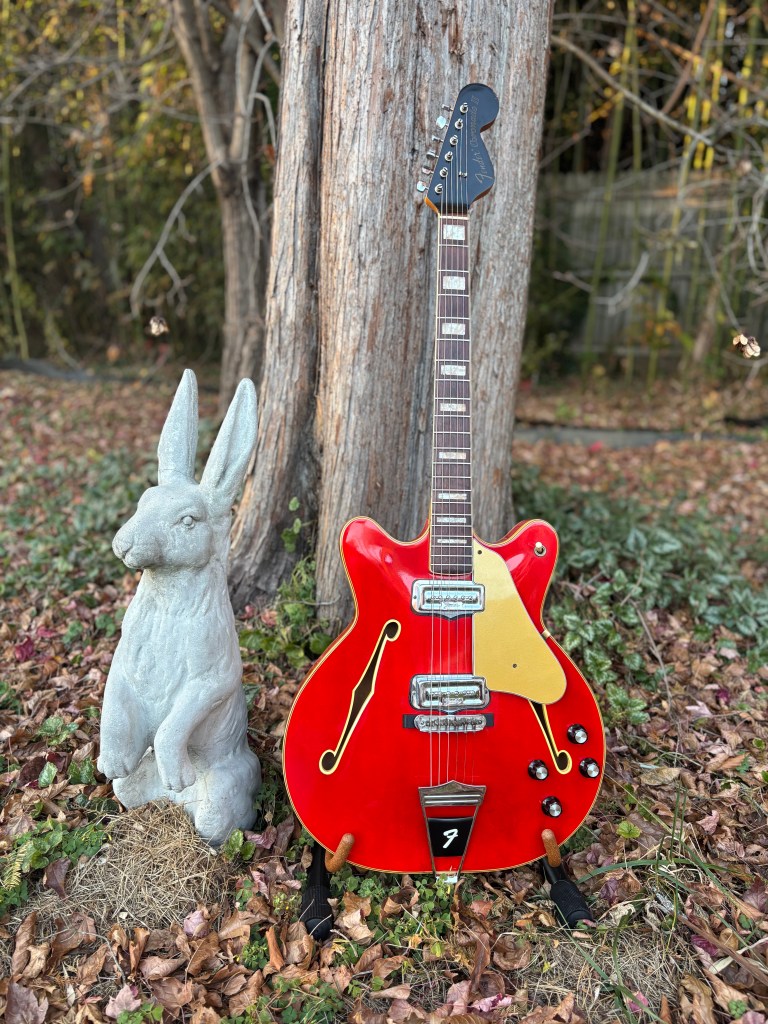
A Brief and Incomplete History of the Coronado II
Let’s start with some historical context. The Coronado is a controversial creation born during a transitional period in Fender’s history.
Leo Fender started his namesake company in the late 1940s. Within a few years, Fender introduced many of the iconic instruments that musicians know and love like the Telecaster, Stratocaster, and Precision Bass. He also introduced important amplifiers like the Twin and Deluxe.
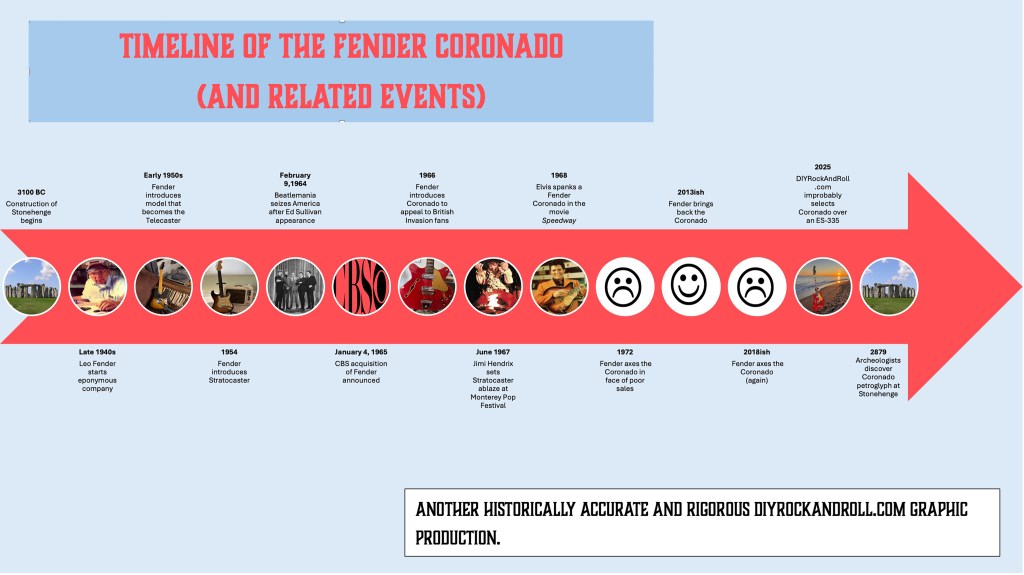
These industry-changing products brought significant growth. By the mid-1960s, the privately-owned company had changed dramatically. In his history of the Gibson/Fender rivalry, The Birth of Loud, Ian S. Port excerpts a telling passage from a 1964 consultant’s report on the company: “Mr. Fender finds it hard to believe that the little business which he started in the late Forties has grown to such proportions. He finds that the size of the business is such that he has virtually no time left for doing what he enjoys, namely, engineering. He is clearly not growth minded.”
According to Port, the Columbia Broadcasting System (CBS) agreed to purchase Fender for approximately 13 million dollars on October 16, 1964. CBS and Fender announced the deal on January 4, 1965. In an article published the next day, the New York Times quoted CBS executive Goddard Lieberson as saying, “This is a fast growing business tied into the expanding leisure time market . . . We expect this industry will grow by 23 percent in the next two years.” Lieberson also told the Times that CBS had “plans for expansion of all kinds.”
Fender’s product line proved to be one area of expansion under CBS ownership. According to Dave Hunter’s Fender: The Official Illustrated History, CBS wanted to get in on the equipment of the British Invasion, particularly “the thinline hollowbody electric Epiphone and Gretsch models that the Beatles played at one time or another.” To create a Fender rival of those models, the company turned to Roger Rossmeisl, who had been a key innovator at Rickenbacker and who had also developed Fender’s acoustic guitar offerings in the early 1960s.
The result was the Fender Coronado, which rolled out in 1966. According to Fender, the Coronado product line included “the single-pickup Coronado I, the dual-pickup Coronado II, the 12-string Coronado XII, and Coronado basses in single- and dual-pickup models.”
On its release in 1966, the guitar was unlike anything else Fender had produced. Fender built its name on solid body guitars, but the Coronado was a full hollowbody. Fender was famous for its original pickup designs, but the Coronado had DeArmond pickups more like those associated with Gretsch. Fender’s most iconic guitars were no frills player’s instruments; but the Coronado was ornate with its block inlays and extensive binding.
There were other Coronado quirks too. For example, in 1967 Fender introduced “wildwood” finish as an option for the Coronado. Rather than simply painting the guitar, Fender decided it would be a good idea to change the color of the wood itself by “injecting colorful dyes into beech trees.”
By 1968, the Coronado had achieved Hollywood stardom. In Speedway, the King of Rock and Roll, Mr. Elvis Presley, repeatedly spanks a sunburst Coronado and even pretends to play it! No, I’m not speaking figuratively. Presley literally spanks the Coronado. Check it out:
Sounds like a happy ending, right? Leo sells his company for big bucks, CBS unveils a new guitar for the swinging sixties, one of the biggest musicians ever plays that guitar in a movie, and then the Coronado joins the Stratocaster and Telecaster as one of Fender’s most iconic models. Well, not quite . . .
Bad Reputation
You see, the Coronado has a bit of a bad reputation. A handful of recurring complaints have haunted the Coronado for decades.
First: feedback. Fender may have been trying to chase the popularity of British Invasion rock bands, but the Coronado has long been condemned for generating uncontrollable feedback at anything approaching rock volumes. To some degree, this is an inherent attribute of any hollowbody electric guitar. But some claim that the Coronado is particularly prone to squealing discontentedly at high volumes.
Second: quality control. If you search online forums for discussions of the Coronado, you’ll probably see comments about dodgy build quality ranging from buzzing tailpieces to weak construction. Some debate the quality control (or lack thereof) of the CBS era more broadly. But some manufacturing issues were unique to the Coronado. For example, in his recent article for Guitar World, Tony Bacon describes a production issue with the Coronado “where burns marked the guitar during the binding process.” (Fender’s solution, according to Bacon, was “the introduction in ’68 of a special white-to-brown shaded finish, named Antigua, intended to obscure any scorches.”).
Third: the pickups. The DeArmonds used on the Coronado are polarizing. I’ve seen detractors call them lo-fi and microphonic.
Fourth: frets. The Coronado, like many other vintage guitars, has teeny little frets. Some complain that string bending is tricky as a result.
I’m sure there are other gripes (lack of sustain, etc.). It’s hard to say what combination of factors kept the Coronado from finding an audience. To some degree it might have been price, since Coronados were relatively expensive instruments. Premier Guitar speculates that feedback deterred rock guitarists, while jazz players were dubious of the Coronado’s bolt-on neck. I wonder if another factor was timing. Fender intended the Coronado to cache in on Beatlemania, but rock music was getting heavier and louder by the time the Coronado dropped in ’66. And by 1967, Jimi Hendrix was making a pretty good case with his Stratocaster that Fender actually had things right all along with its solid body guitars.
Regardless, Fender discontinued the Coronado around 1972. To this day, the company seems to be a bit sheepish about the Coronado. An article on the Fender website says that the “original Coronados, although designed as high-end instruments, went down in history as a short-lived ‘nice try’ on [the company’s] part.” Fender resurrected a version of the Coronado in the 2010s. The new Coronados sold for well under a grand and featured a semi-hollowbody design with Fideli’Tron pickups. As best I can tell, they too failed to light the world ablaze. Fender quietly discontinued the new Coronado after a few years.
Despite the bad reputation, today the Coronado has a dedicated cult following, as evidenced by an enthusiastic, helpful, and engaged Facebook owners/fan page. The guitar has had a few high profile users like Jimmie Vaughan. And every now and again you’ll see or hear speculation about increasing collector interest.
So who is right? Is the Coronado worthy of its bad reputation, or is it a sleeper-classic in the vintage guitar market?
My Experience with the Coronado
Part I: How my quest to find the perfect ES-335 got derailed by a Coronado II
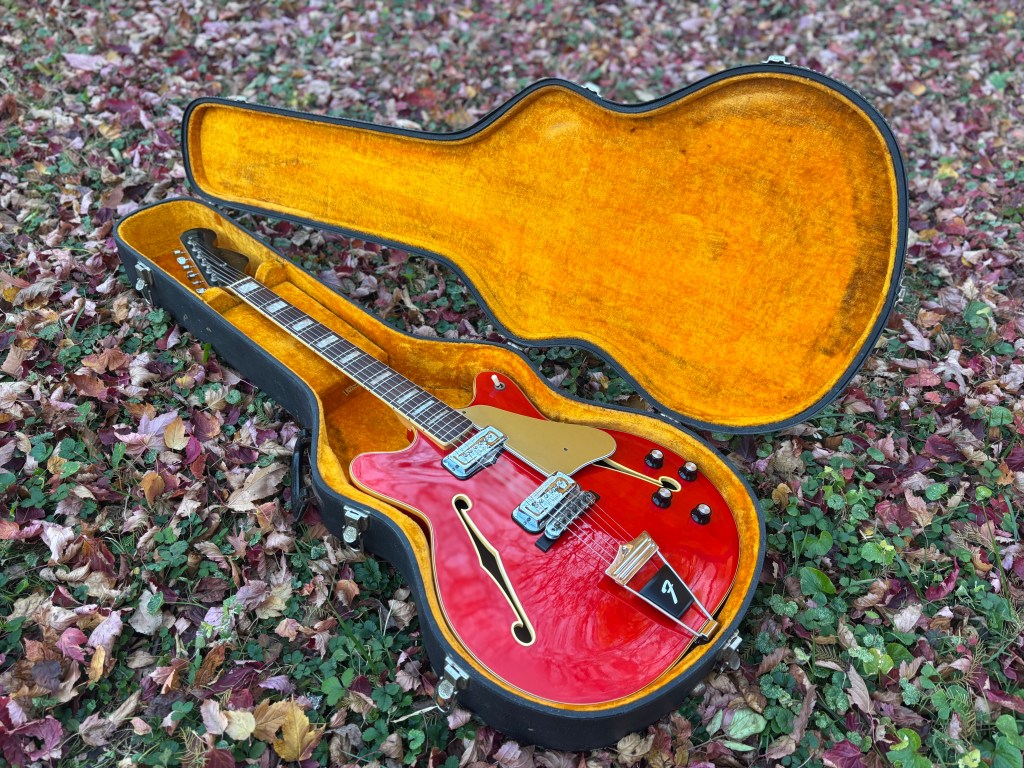
Before I dive into my Coronado review, I should explain how I ended up with one of these controversial instruments in the first place.
I’ve wanted a Gibson ES-335 since high school. As a huge Chuck Berry fan, I’ve always thought of a red ES-335 as the quintessential rock guitar. And as a blues lover, it’s hard not to get fixated on other guitars in the ES family, like B.B. King’s various Lucilles.
A while back I decided to finally go for it. I made space by selling my first electric guitar (a Gibson Les Paul studio that was a nice instrument but that made me feel like a giant with its little body). I saved some money and I started shopping.
But I had trouble finding a 335 that I connected with. (Editor: Before we get any hate mail from Gibson fans, DIYRockAndRoll.com wants to clarify that this is not intended as an objective assessment of the merits of ES-335s. Connecting with a guitar is a subjective affair, and the author of this article clearly has some whacky taste in instruments). Maybe I didn’t find a “good” one; maybe they needed a set up; maybe it was me. (One exception was a used Gibson Lucille from 2001, which I’ll file under guitars that got away. Heavy, but glorious).
Somewhere in my process (Editor: mania?), my hunt for a 335 morphed. If the more recent 335s weren’t doing it for me, maybe a vintage guitar would. I also thought it might be fun to have something with a bit of history and patina. The problem is that the vintage 335s from the ’50s and ’60s are astronomically expensive. That left me wondering whether I could find a great ES-335 from the ’70s or ’80s, or a competitive model from a different manufacturer.
I got pretty close with some Guild Starfire IVs, but something always went awry. (Another one to file under guitars that got away: a spectacular 1974ish red, Westerly Starfire IV with HB-1 pickups at a Guitar Center in Rhode Island, which someone bought while I was playing it! Lucky guy!).
Then, one weekend, I made an appointment with a vintage guitar shop in Maryland to test out a 1978 Gibson ES-335TD. It was old enough to have some personality, but not so old that I would have had to sell my car to purchase it. Since the drive was a bit of a haul, I had asked to test out a few of their other guitars on a whim. Those included a 1960s Guild Starfire II, a 1978 Telecaster Custom, and . . . a Fender Coronado II. I was dimly aware of the Coronado’s reputation, but it looked cool on the website. I figured I’d try it, hate it, chuckle to myself, and rule it out as yet another red herring in my search.
When I got to the store, the unexpected happened. The ’78 ES-335 didn’t blow me out of the water like I really wanted it to. Instead, I kept going back to the Coronado. To my surprise, I found it kind of charming. The shape and gently worn-in feel of the neck felt great. I loved the size and contours of the body. It was light. It sounded resonant unplugged. Plugged into the store’s Princeton Reverb, the pickups were really interesting. Plus, I loved how it looked. It was so sixties. In person, the Coronado reminded me of a pony car or a prop from the original Star Trek. I couldn’t get it out of my head. Within a couple hours of leaving the store I had decided to buy it (even though my wife said it looked like Ronald McDonald).
This probably makes me the first person in history to try a Fender Coronado II and a Gibson ES-335 back-to-back and choose the Coronado. So, do I regret it?
Part II: Putting the Fender Coronado’s Reputation to the Test
Mostly, I think the Coronado is fantastic. My biggest issues relate more to the risks of buying a vintage guitar in general than anything having to do with the Coronado itself. Let’s break out my experience, arranged by some of the various Coronado myths discussed above.
Myth 1 – Coronados May Have Quality Control Issues: Some Truth
As I mentioned above, one shadow hanging over the Coronado’s head(stock) is a poor quality control reputation. My 59-year-old guitar came with two notable condition issues.
The first one is probably an example of inconsistent quality control from Fender. After playing my guitar at home at higher volumes, I realized that the bridge pickup sounded anemic and quiet compared to the neck. My go-to technician discovered that the bridge pickup had been wired incorrectly. His opinion was that the wiring issue was original to the guitar, which would mean someone goofed at the Fender factory. Fortunately, it was a cheap and easy fix.
The second condition issue is that my Coronado came with a slight neck twist. This is probably more of an inherent risk with buying old guitars in general than it is something unique to the Coronado. I am annoyed with myself for not discovering the twist at the shop before purchasing the guitar, but you live and you learn. It only became apparent after a setup dropped the action a bit. This is where the Coronado’s teeny vintage frets are a shortcoming, since they don’t leave any room for leveling to accommodate the twist. Since I’ve decided I like the Coronado, I’ll invest in a re-fret at some point. For now, the guitar plays well enough with tolerable action.
Myth 2 – You Can’t Rock on a Coronado Because of Feedback: Overblown
I play in a bar band that’s pretty loud (I’ve been told around 100db). It has four guitarists and the room we play in has live acoustics and is fairly small. If anything is a recipe for feedback, surely that’s it.
But what’s the point of having an attention-grabbing guitar with outrageous, space-age aesthetics if you can’t play it out? To heck with the feedback reputation! After a few months of enjoying the Coronado at home, the temptation to try it in a live setting proved too strong.
I was apprehensive about trying the Coronado live. Based on internet comments, I almost imagined that a lightning bolt would shoot from the sky as soon as I flipped on the amp. How dare you defy the god of feedback!? That’s a slight exaggeration, but I did worry that the Coronado would clear the room by producing a wild and uncontrollable squeal. I brought a backup guitar just in case, but it stayed in its case. The Coronado was totally fine with some modest supervision. There was a small amount of usable feedback that I was able to control with my palm, volume knob, or tuner pedal. The feedback was kind of cool.
Here are a few samples of my Coronado live (these were shot on a smart phone so apologies for the lousy video/audio quality).
Live Blues Rock on a Fender Coronado II: All the lead guitar licks on this one are on the Coronado. I think it was the neck pickup going through a Nocturne Brain Junior Barnyard and a Wampler Plexi Mini into a Quilter Aviator Cub.
Live Quasi-Rockabilly on a Fender Coronado II: the short solo on this is also on the Coronado. I think this was the bridge pickup going through the Junior Barnyard, Plexi Mini, and Boss TR-2, into the Aviator.
Live Bakersfield Country on a Fender Coronado II: here’s an excerpt of Long White Cadillac featuring a solo on the Coronado (which would have been better if I hadn’t been messing around with my settings hahaha).
Now, there are situations where the Coronado’s feedback reputation is real. I have found that it does not get along well with my fuzz pedal. I also imagine that it might be a poor choice if you’re planning on plugging your Coronado into some cranked Hi-Watts or a maxed out Fender Twin. And I can see why that kept the Coronado from catching on with rockers back in the day when that was the only option to play large venues. In an age where so many artists mic smaller amps into a PA, I wonder if that would still be an obstacle. If I ever get a chance to test it, I’ll be sure to let you know!
Myth 3 – The Tone of the Coronado’s Pickups is Lackluster: I Strongly Disagree
I think the DeArmond pickups on the Coronado are distinctive and inspiring. They have opened up a world of sonic possibilities and are a blast to record with. There’s a reason the Coronado is on all three DIY projects so far. In the jump blues project, I dialed in sort of a vintage jazzy tone:
In the surf rock project, the Coronado neck pickup created a twangy Duane Eddy kind of thing:
And, as somebody on the Coronado Facebook fan page told me, the Coronado sounds phenomenal with gain. As I detailed in my recent blues rock post, the thick overdriven sound of the Coronado took my project to terrain I never would have expected.
I also think that the tone controls on the Coronado do more useful things than on any guitar I own. Some guitars go from sharp to mud with little in between. The Coronado offers a ton of variation.
Myth 4 – You Can’t Bend Strings on a Coronado: False (If It’s Correctly Set Up)
It might take a bit more finesse than it does on a guitar with larger frets, but I’ve had no trouble bending on the Coronado. I wondered if it would be an issue on Matthew Sweet’s Girlfriend (video above) since it’s a pretty bendy song. I thought the Coronado accepted bends very nicely despite its teeny frets and neck twist. (I do use lighter gauge strings.).
Myth 5 – The Body Strap Button Is In a Stupid Place and Only Works With Vintage-Style Guitar Straps: True!
Ok, I cheated. This isn’t a myth, but I wasn’t sure where to fit it in. One of the strap buttons is under the base of the neck rather than on the horn. It’s a bit obnoxious.
Part III: Other Things I Really Like About the Coronado That Didn’t Fit Above
Creative Muse:
If you are into songwriting and recording, I think the Coronado is kind of a magic guitar. I’ve found that if I need something to happen with an electric guitar part in an arrangement or mix, but I’m not sure what it is, I can often get inspiration by pulling out the Coronado. As detailed in other posts, its quirky personality and unique voice often bring out ideas that I wouldn’t have thought of otherwise.
Ergonomics:
I don’t think the Coronado gets enough credit for being a very comfortable guitar to play. The shape and size are great standing or sitting, particularly if you’re tall. If you are playing standing up, you’ll almost certainly appreciate the Coronado’s light weight. Fret access is good.
Aesthetics:
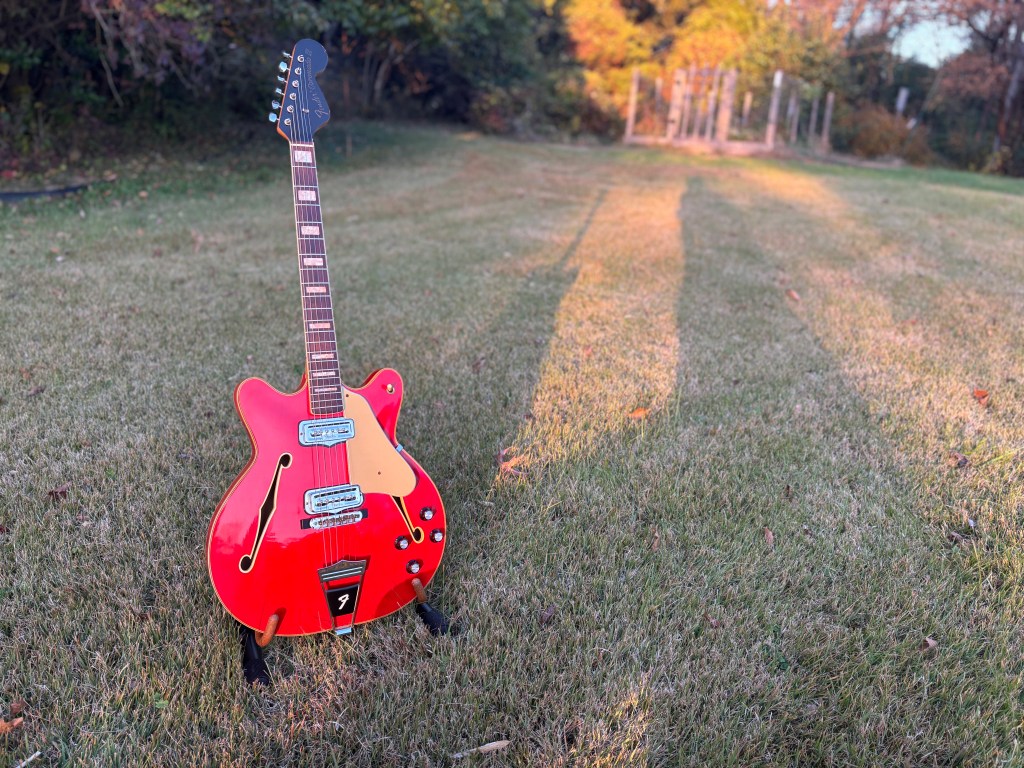
If you’re looking for a guitar that will turn heads, the Coronado is a great option. For one thing, it’s unusual so there’s a decent chance a lot of people will never have seen one. But even if they have, there’s something about the Stratocaster headstock affixed to a thin-line hollowbody that demands attention, particularly with the chrome pickups, binding, and vibrant finishes.
Tuning Stability:
It really makes me cranky when guitars won’t stay in tune. The sound of a guitar with a sour G string is exhausting. My Coronado holds tune very well. The tuning stability is not quite as good as it is on my 21st Century American Strat and Tele (both of which have locking tuners), but it’s surprisingly close.
Conclusion
Buying a vintage Coronado is kind of like buying an antique car. Modern cars perform better and require less upkeep. But a classic car can turn heads with its vintage design and can make you feel different while using it. Same with the Coronado. You might not want a Coronado to be your only guitar in the same way you maybe wouldn’t want a Studebaker Avanti to be your daily driver. But the Coronado can still be a great addition to a collection. That’s particularly true if you’re looking for a guitar to add some sonic variety to recordings.
If you are interested in adding a vintage guitar to your collection, the Fender Coronado feels like an end-run around astronomical vintage guitar prices. For a fraction of the price of a 1960s Stratocaster or Telecaster, you can get a high-end guitar from the same company from the same period. There’s something really enjoyable about playing a guitar with naturally aged binding and a vintage neck. . . a guitar that’s survived for decades and is ready for more.
Will the Coronado ever become as collectible as its better-known peers? I don’t care. I’m having too much fun playing it.
 DIY Rock and Roll
Pingback: Review: Fender American Ultra Luxe Telecaster | DIY Rock and Roll
Pingback: DIY Hard Rock: My Journey Recording Carolina Girl | DIY Rock and Roll