Or, the rock tradition of reworking an acoustic blues song into electric guitar abandon.
For my third experiment in DIY rocking, I thought it was time to create something worthy of the name of this website. I didn’t want to share another oblique expedition into the roots of rock (Editor: see post one on surf rock and post two on boogie-woogie). Instead, I wanted to make an unapologetically hard-rocking song with self-indulgent guitar solos played through amps cranked to the edge of oblivion. It was time for a piece of fist-in-the-air rock and roll. Or should I say ROCK?
For my first foray into that realm, I decided to play to my experience as a blues musician and try my hand at blues rock. The resulting recording took several weeks and involved musical tangents, new equipment and techniques, and a lot of experimentation. Recording it made me feel a bit like a mad scientist concocting an elixir or making a monster. I can’t promise that my notes are complete or that the experiment is replicable. But, as best I can recount, here’s how I put together my newest DIY experiment Lonesome Valentine.
Blues had a baby named rock and roll: context and a brief, incomplete history of blues rock
Ordinarily my DIY Rock Experiments are largely an excuse to share music history that I’m passionate about. Until now, providing that music history has also felt necessary to explain or justify why I’m featuring a particular genre like R&B on a website dedicated to rock music. I’m not sure that’s really necessary here, since Lonesome Valentine is blues rock. The term “blues rock” feels self-explanatory and even a bit redundant because so much rock music is essentially blues music. As Muddy Waters sang, “well the blues done had a baby and they named the baby rock and roll.”
If you follow rock back to its genesis, it’s easy to see what Muddy meant. For instance, I think that the first rock and roll recording is actually a revved up blues song by a blues group: Little Junior Parker and his Blue Flames’ 1953 recording of Love my Baby.
The influence of blues on early rock is undeniable, even if you disagree with me on the first rock recording (somewhere out there is the guy who called into my college radio show to argue with me and tell me that Bill Haley started rock and roll with his 1954 recording of Rock Around the Clock). Elvis Presley’s first Sun Records single in 1954 was a cover of a blues song, namely Arthur “Big Boy” Crudup’s That’s All Right. Elvis quickly followed it up with other blues covers like Crudup’s My Baby Left Me and Junior Parker’s Mystery Train. In the mid-fifties, pioneers like Chuck Berry and Bo Diddley were turbocharging blues progressions and riffs to build the bedrock of, well, rock.
And here I was saying that I didn’t need to burden you with my armchair musicology this time. Whoops! Well, let me just cut ahead to the 1960s to note that the influence of blues on rock music continued unabated with a new generation of blues-obsessed musicians. For proof, just look to the enormous volume of great blues covers by rock acts from both sides of the Atlantic. It’s also apparent in all of the original material from artists like Jimi Hendrix and The Rolling Stones, which incorporated blues instrumentation, riffs, solos, and chord progressions. All of this is well-trodden music history. So, rather than writing a blow-by-blow of all of the blues rock that I’m paying homage to in Lonesome Valentine, I put together a Spotify playlist of rocking blues and bluesy rock. It runs the gamut from Little Walter and Little Junior Parker to the White Stripes and the Black Keys, with many stops in between. It’s available here if you want to check it out!
My Project: Lonesome Valentine
Some of the best blues rock recordings are electric covers of older acoustic blues songs. Many are covers of material written by or associated with Robert Johnson, like the The Rolling Stones‘ or White Stripes‘ versions of Stop Breaking Down, Cream’s performance of Crossroads, or Led Zeppelin’s interpretation of Travelling Riverside Blues. Besides this sub-category of Robert Johnson covers, rock artists have interpreted acoustic blues staples by musicians like Sleepy John Estes (Drop Down Mama; Milk Cow Blues), Memphis Minnie (When the Levee Breaks), Hambone Willie Newbern (Rollin’ and Tumblin’), and many others. One particularly famous example is Blind Willie McTell’s Statesboro Blues. It was covered by Taj Mahal in 1967, whose interpretation in turn inspired one by the Allman Brothers.
In light of this tradition, I decided to base my own blues rock project on an earlier acoustic blues number. I picked the song Lonesome Valentine by the little-known North Carolina blues and country musician Peetie Nixon. Peetie Nixon is perhaps best known as one half of the Nixon Brothers. Okay. Fine. You caught me. Peetie Nixon isn’t best known in any context. Why? Because Peetie Nixon is . . . me. Well, at least it’s a musical alter ego. (Editor: Stop the presses! Peetie Nixon’s identity, subject of rampant speculation by up to four internet listeners, is finally confirmed). All kidding aside, you can hear how the song started life below. Reworking this skeletal, faux field recording into a raucous rocker required at least eight steps.
Step One: Reimagining the Rhythm Guitar
A key part of my original recording of Lonesome Valentine is the 1936 National Duolian resonator guitar that I wrote and played it on. It’s a guitar with more blues cred than I’ll ever have. This particular Duolian has a unique sound. It’s punchy without being harsh. Unlike some resonators, it actually has a fairly sweet sound. It also has a huge neck that’s great for fingerpicking.
I wanted to stick with the Duolian to be true to the original recording and because I thought it would give a great texture to the recording. Although fingerpicking made sense for my original unaccompanied recording, I knew I needed something more driving as the backbone for a rock version. After some experimentation, I came up with the chunky strum pattern that you can hear best in the first few seconds before the electric guitars begin. After that, the Duolian sounds more like additional percussion when blended with the other instruments.
Step Two: Drums and Percussion
I find that the biggest obstacle to DIY rock recording is my lack of drums and percussion. My first two DIY Rock projects used drum loops and samples. For this project, I wanted something much more organic and flexible. Lonesome Valentine is my first project to feature a recent acquisition, a Yamaha FGDP-50 Finger Drum Pad. The FGDP-50 is kind of a weird creature. It’s sort of half-way between an actual instrument and a toy. It comes preloaded with a bunch of different “kits” that range from a classic maple drum kit to DJ/EDM sets that remind me of the Casio keyboards that were in my middle school’s band room in the 2000s. You play the kits by tapping your fingers on little rubbery pads. The FGDP-50 has a little speaker, which is fun but not overly realistic. For this project I mainly used the FGDP-50’s “hard rock” kit, plugged directly into GarageBand via USB-C. Look, nobody is going to mistake it for Art Blakey or Keith Moon. But for recording a basic rock rhythm track I think the FGDP-50 sounds way better than it has any right to. Unlike some of the more expensive MIDI/finger-drum controllers on the market, the FGDP-50 is also very easy to use. I’ll probably be using it a lot moving forward unless I have access to a more realistic DIY percussion instrument.
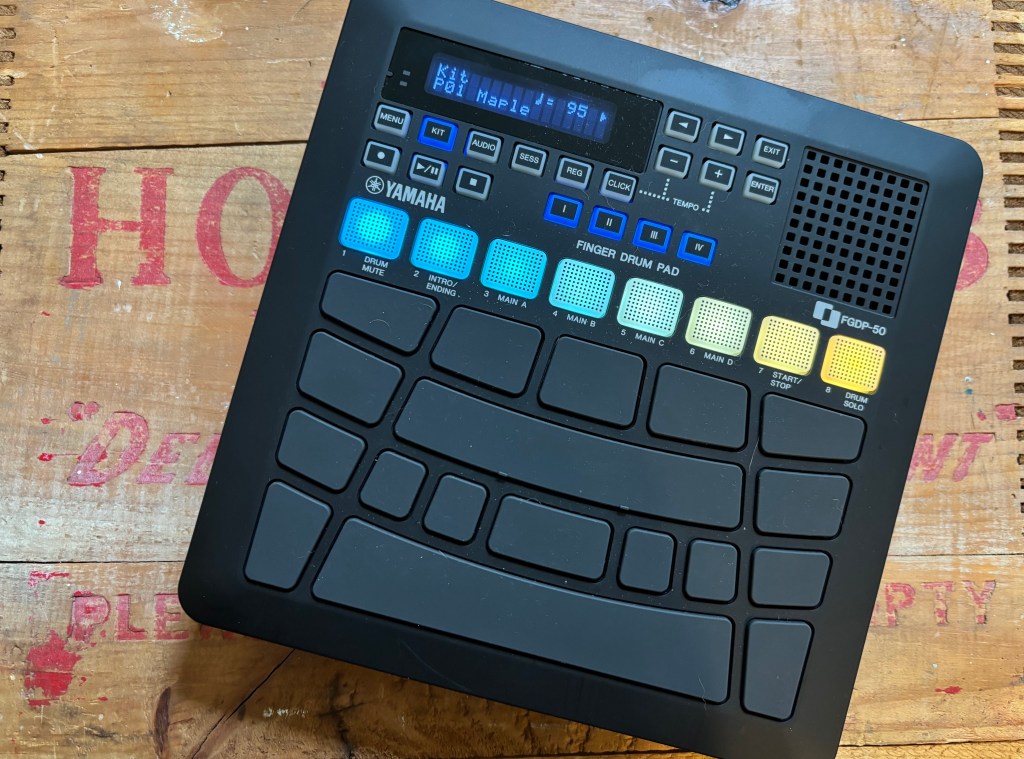
Figuring out the FGDP-50 is one thing, figuring out how to write, perform, and record a drum part is another. My initial attempts were awful. My first idea was to record a scratch track of guitar and vocals and then overdub the drum part, and rerecord on top of that. The result was embarrassing. The rhythm was so erratic it almost demanded immediate attention from a cardiologist. If I’m honest, a subsequent attempt to record the drum part over a metronome also failed miserably. Only a time traveler could have processed the passage of time between beats more inaccurately than I apparently did.
Ultimately, I used a Boss RC-5 loop station and recorded one of its rhythm tracks set to my desired tempo. Then, I used my FGDP-50 to record the basic drum track over that. I deleted the Boss RC-5 part, and then layered the instruments and vocals on top of the FGDP-50 parts. Even still, I had to go back in and rerecord and tweak the drum parts a number of times as I added other instruments.
Step Three: Electric Bass
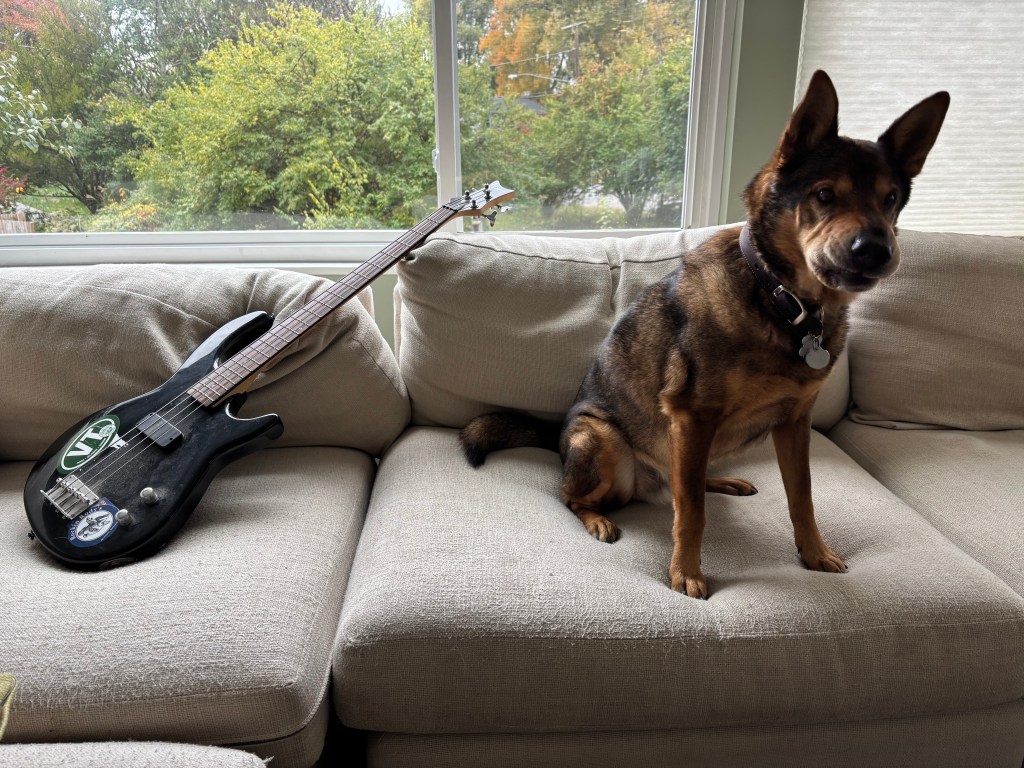
I had a lot of fun playing the bass on this one. I wanted a simple bass part that would glue the song together and add some momentum and intrigue in the right places. I wanted to emulate Bill Wyman. Ultimately, I largely mirrored the rhythm guitar part. There’s not too much to say about the equipment here. I employed the same cheap Dean electric bass I used on Coronado. I plugged it into GarageBand via a Focusrite Scarlett 4i4. I used GarageBand’s built in “60’s Combo” setting, although I tweaked the EQ a bit for a bigger sound.
Step Four: Electric Guitars
The electric guitar parts drove the creative evolution of Lonesome Valentine more than anything else. My original idea was to do some Rolling Stones-style “weaving” where the electric guitars seamlessly trade rhythm and lead parts. This was quite a puzzle for a DIY rocker relying entirely on overdubs. I ultimately did piece together a version that I thought was promising, but I abandoned it after a fluke discovery that changed the course of the recording entirely.
Enter the hero of the first two DIY experiments: my 1966 Fender Coronado II. The Coronado has a dodgy reputation for feedback issues at high volumes, which has contributed to a lack of respect from many guitarists. The irony is that if you can escape the feedback, the Coronado sounds incredible with gain. Its tone is huge and thick, yet remarkably articulate. Anyway, I was goofing around with the Coronado one night with a preposterous amount of overdrive. I decided to play the rhythm guitar riff for Lonesome Valentine out of curiosity. The sound floored me. So much so that it inspired me to scrap the nearly-finished version with woven guitars and to completely redo the electric guitar parts.
For any gear heads out there listening in stereo, the Coronado is mixed primarily to the right. The sound is the Coronado going through my Nocturne Brain Junior Barnyard pedal, into a Wampler Plexi Drive Mini, into a Carr Super Bee. In other words, the Coronado’s old DeArmond pickups were going through one pedal designed to replicate a saturated 1940s octal tube amp, through another designed to evoke a cranked Marshall stack, and into an amp itself capable of recreating the sounds of an overdriven Fender Super Reverb. I also added a bit of slap back from an MXR Carbon Copy Mini.
With the guitar weaving idea abandoned, I had to record a dedicated lead guitar part. The lead guitar part consists of solos, fills, and a riff at the start of each verse. That lead-off riff is taken from my original acoustic version, although I had to rework it a bit to fit the new rock rhythm.
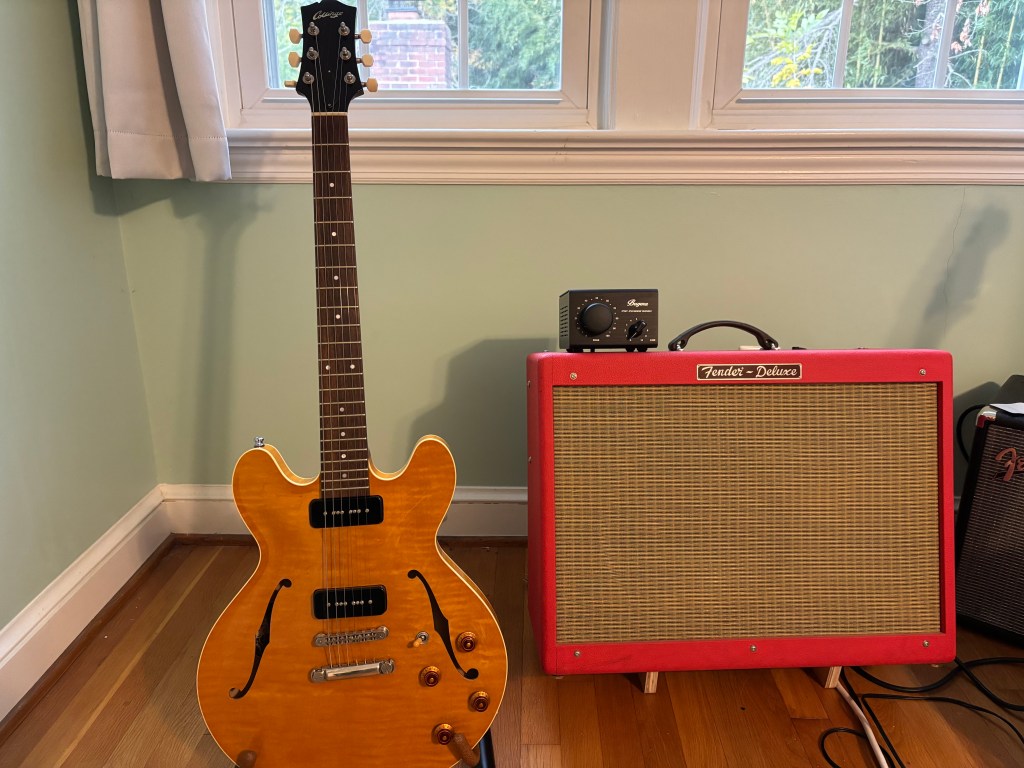
The lead guitar is mixed primarily to the left channel or to center for solos. I wanted a sound that would stand out from the Coronado, but still match its intensity. To achieve that, I thought it made sense to use a different amp. By process of elimination, that meant I’d be using my trusty Fender Hot Rod Deluxe. A huge part of the lead guitar tone on Lonesome Valentine is the Hot Rod Deluxe cranked all the way up (for any Spinal Tap fans, the Hot Rod Deluxe goes up to 12!).
Ordinarily, getting that much gain out of a Hot Rod Deluxe would require hearing protection and forgiving environs. I was able to do it without either, because of a not-so-secret weapon: a Bugera PS-1 power soak. The PS-1 is an entry-level power attenuator, which essentially soaks up volume between the power amp and the speaker so that you can get natural preamp and power amp tube saturation at reasonable volumes. Purists claim that power soaks ruin tone, particularly cheap ones like mine. There might be some truth to that. I’ll be sure to report back in the unlikely event I ever perform in a large enough venue to find out. (Editor: If you have a Hot Rod Deluxe that you’re struggling to tame, another possibility to investigate is the JHS Little Black Box).
Between the PS-1 and the Hot Rod Deluxe, I was able to obtain a terrific amount of overdrive. I used an MXR ten-band EQ pedal to gently boost and round out the amp’s natural sound. As with the rhythm guitar, I also added a little bit of delay with the MXR Carbon Copy mini. As a rockabilly fanatic, I can’t get enough delay, even in the harder blues rock context.
The last ingredient in the lead guitar sound was, of course, the guitar. I used a Collings I-35 LC. It’s a phenomenal instrument that will hopefully be the subject of a future post. It’s essentially their version of a Gibson ES-335, although this one has Lollar standard-wind P-90 pickups that can really scream. Going into the cranked Hot Rod Deluxe, they had the opportunity to do so.
Step Five: Lead Vocals
Recording vocals that worked with the growling guitar parts proved an interesting puzzle. I think the most obvious fit would have been power vocals. If only I could sing like Wilson Pickett! Screaming guitars and scorching soul vocals… what a combo.
But I can’t sing like the wicked Pickett. And I also can’t sing like Bon Scott, or Howlin’ Wolf, or Mick Jagger. As it is, my voice is far better suited to singer-songwriter and Americana type stuff than it is to rock, let alone ROCK.
My first vocal efforts for Lonesome Valentine closely mirrored the phrasing in my original acoustic performance, albeit in my chest voice. The result didn’t have enough spark to match the instrumental arrangement.
One breakthrough came after listening to a CD of Charley Patton on repeat in my car. Although there’s no universe where I could sing in Patton’s range with his intensity or skill (it’s as improbable as the universe where I could sing like Wilson Pickett), I was still inspired by his phrasing. On subsequent takes, I tried to be a bit more conversational and intentional in the timing of the lyrics. That helped, but the vocals still didn’t really do anything for me.
The second breakthrough came by accident. I had just finished a vocal take in my chest voice, and was listening to the guitar solos at the end of Lonesome Valentine. I realized that they went on a little bit too long and that they needed something to keep the song interesting. Remember the start of this article where I was talking about Little Junior Parker and the birth of rock? Around the 3:44′ mark, the lead guitar part is a loose tribute to Junior Parker’s epic Feelin’ Good. I thought it might be interesting if I improvised a throwaway vocal verse nodding to Parker since he’s a true musical hero of mine. Of course, Junior Parker is also on the list of amazing singers I could never dream of replicating. But to get somewhere in the right spirit, I started quietly singing in falsetto about wanting to boogie. I already had a decent amount of gain, compression, delay, and ambience on the track to try and make my chest vocals stand out. Through those effects, the falsetto reminded me of the early blues rock/rockabilly discussed above. Although it was certainly not a hard rock sound, the rockabilly vocals popped more than any of my previous attempts. I decided to embrace my nasally voice rather than try to obscure it, and I went back and rerecorded the earlier verses in the same head voice with my Patton-inspired phrasing.
In a sense, the lead vocals went full circle since my original acoustic recording was also done with a softer, nasally head voice.
Step Six: Backing Vocals
I can’t quite remember when I thought of adding backing vocals. I think it was about halfway through the project when I realized I needed something to make the back-to-back guitar solos at the end of Lonesome Valentine a little more interesting. After some trial and error, I added vocals of myself singing “a lonesome valentine” at the end of every 12 bars. To give the song a sense of progression, I eventually paired that down so that the backing vocals begin right before the first guitar solo.
My original backing vocals were meant more as a placeholder than anything else, although I ultimately kept them in the mix. Most of the backing vocals are courtesy of my wife Katherine, who has a legitimately good voice and actual vocal training (imagine!). At my urging she recorded her parts in two different octaves. I blended her vocals with mine and used some chorus effects and EQ to make the backing vocals more blended and cohesive.
Step Seven: Mastering
After mixing all of the tracks together I thought that Lonesome Valentine was ready to go. I was excited! I exported the song from Garageband, connected my laptop to my stereo, hit play, and . . . it was just awful. The mix sounded anemic and muddy. All my effort had resulted in an amateurish sounding product.
I realized that I needed to do something I’d never bothered with previously in my DIY projects–mastering. I love writing, arranging, and performing music, but I don’t particularly enjoy sound engineering or music production. But, it was a necessary evil. I won’t regale you with the mastering process because it was nasty, brutish, and longggggg. I will say that if you’re in the same predicament, I found the Band Guide‘s free YouTube series to be incredibly helpful. His video on mastering is particularly useful. I must have rewatched it at least five times. If you don’t like the mastering on Lonesome Valentine, the fault is entirely attributable to my skillset, not to the Band Guide’s instructions. Regardless, trust me that the mastered audio was a vast improvement over the unmastered.
Step Eight: Cover Art
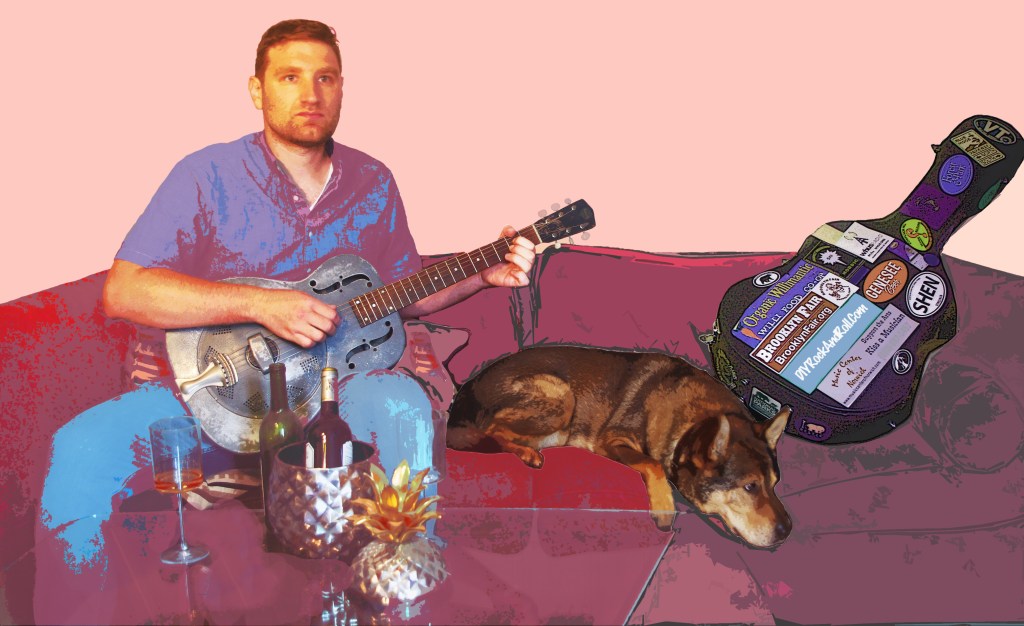
For me, the most enjoyable parts of Lonesome Valentine were recording the electric guitars and making the cover art!
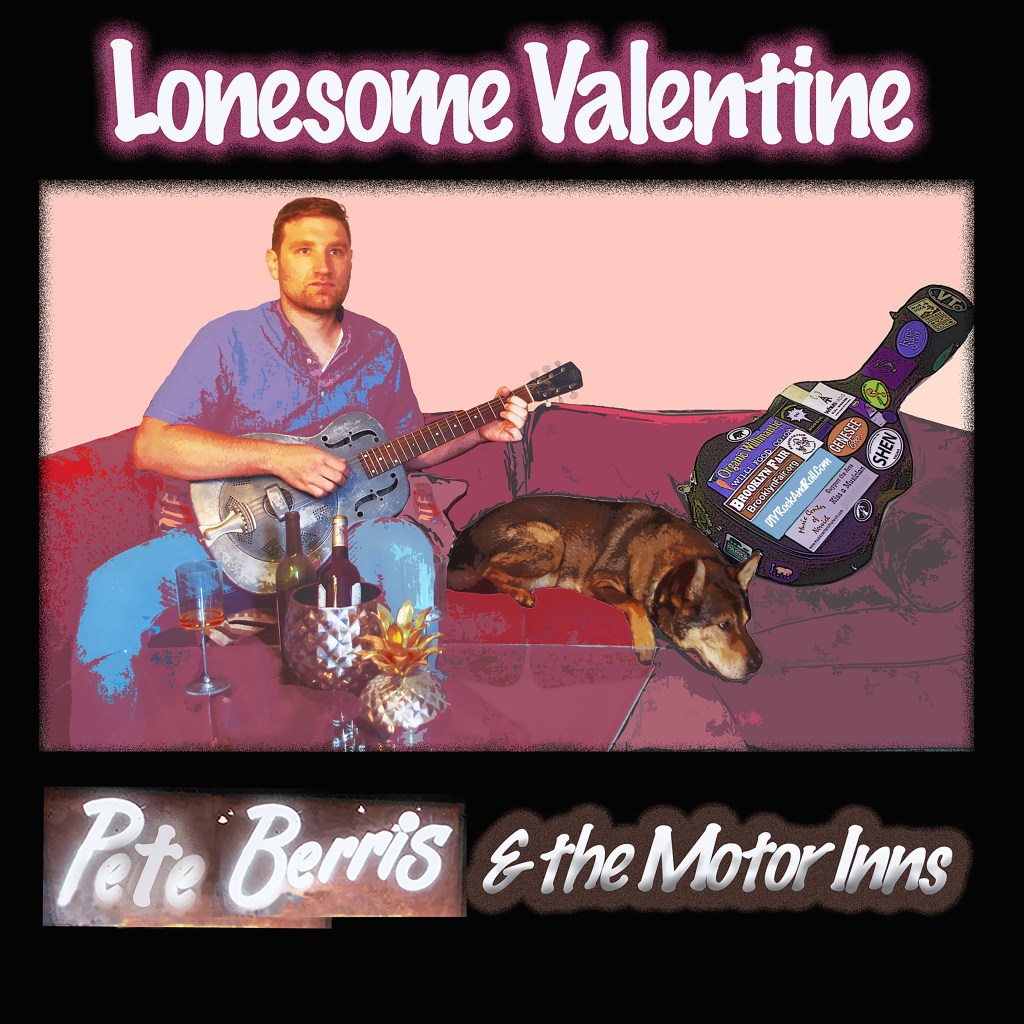
My original idea was to pose wearing all black while holding my Coronado and a red Valentine’s Day card made out of construction paper. After being informed in no uncertain terms this was way dorkier than I realized, I started soliciting concepts from others.
Katherine suggested two ideas. One was a photo of rotting flowers covered in maggots. The other was a table set for two with me in one chair and a guitar in the other. I was out of maggots so I decided to use the second idea for a jumping off point.
From there it was pretty smooth sailing. I set up a camera on a tripod, put out a couple of wine glasses, and posed with the Duolian guitar that helped inspire this song so long ago. Most importantly, I called in a favor from my dog Marvin. I think his expression and pose really makes the cover. Don’t worry, he’s not actually lonesome. Marvin just looks sad because he was bored by the photoshoot and waiting impatiently for his afternoon walk. Anyway, I knew I was on to something with the album art after I sent it to my parents and my mom called concerned that I looked “pensive.” Rock and roll!
Since this is a music blog rather than an art blog, I won’t bog you down with gratuitous details about my Photoshop editing. Every surface in the photo has some kind of effect or filter except for the guitar. The Duolian’s nine decades of patina is more interesting than any posterization effect that I could add.
For the lettering, I kept the neon sign motif I used on Eight Miles Down the Road. The “Berris” is from the actual neon sign for my grandparents’ Motor Inn. I built the other lettering around that. Shout out to my dad who provided helpful feedback throughout the design process.
Conclusion
This was a long post, so here are some quick takeaways! On gear: so far the Yamaha FGDP-50 is a fun and promising percussion tool; a vintage Fender Coronado II can absolutely rock despite its reputation; P-90s are indeed perfect pickups for blues rock; if you have a loud tube amp, do yourself a favor and try an attenuator. On music history: Muddy Waters says rock and roll is an offspring of the blues, and I’m not going to argue. On production: mastering is a huge pain in the [censored], but it does matter. On the creative process: reimagining an acoustic blues song is a great way to practice arranging and improvisation, and can leave you with a product that honors its source material while alchemizing it into something new.
Overall, I had a ton of fun recording Lonesome Valentine and I hope you can tell by listening to the song. Melding songwriting with my love of rock guitar was a rewarding experience that opened up a lot of creative possibilities. If nothing else, Lonesome Valentine is an homage to some of my favorite blues rock going all the way back to the birth of rock itself. In an era where blues rock seems to have lost some of its former ubiquity, it felt nice to pay tribute by making my own version. I hope you enjoy it!
Until next time, don’t let the enemy be the perfect of the good enough for rock and roll!
 DIY Rock and Roll
awesome!!!
LikeLike
Thank you!!!
LikeLike
Pingback: Zombie Blues | DIY Rock and Roll
Pingback: 1966 Fender Coronado II: A Profile and a Review | DIY Rock and Roll
Pingback: Do It Yourself Rockabilly | DIY Rock and Roll
Pingback: DIY Hard Rock: My Journey Recording Carolina Girl | DIY Rock and Roll