And my Continuing Quest for “Quiet” Overdrive for DIY Rocking
From Sun Records at the dawn of rock, to the Who’s Live at Leeds, to the Ramones… so many of the most iconic rock guitar tones were born at high volume. That’s no problem if you’re playing large venues that let you crank your amp to eleven. (If you are, why are you reading this blog?). It’s another story if you’re mostly playing at home. There, it can be challenging to recreate convincing rock tones at volumes that won’t rattle windows, disturb loved ones, and hurt your ears.
I learned this lesson late since I spent most of my time as a guitarist either on an acoustic or playing electric blues with a clean tone. When I became more serious about playing rock and roll (which is to say when I became less serious in general) I discovered that tube amps all got pretty darn loud before I achieved a satisfyingly dirty tone. This was particularly true for my main amplifier, the notoriously-loud Fender Hot Rod Deluxe, which is 40 watts (there are entire forums online dedicated to helping make the Hot Rod Deluxe more usable without causing premature deafness).
There are different “solutions” for achieving dirty rock tones at home volumes, including pedals, solid state amps (sigh), and modeling amps (sighhhh). But there’s something really appealing about the idea of plugging directly into an overdriven tube amp. Personally, I hate fiddling with knobs and dials, so the simplicity of controlling your sound with just your guitar and a tube amp has long been my preference (although I’m softening my stance on pedals).
If you’re looking to get natural tube amp breakup at home volumes, you typically encounter four philosophies online.
- Big amp and no compromises: Buy that Marshall Stack or Fender Bassman, crank it, and enjoy true rock and roll glory as your house turns to splinters. Then, pawn your amp to pay the tickets for noise ordinance violations. It’s better to burn out than to fade away!
- Low-watt tube amp: Get something like a Fender Champ, and turn it up until you achieve natural breakup.
- Master Volume: Get an amp with a master volume control so you can achieve preamp tube saturation at relatively low volumes.
- Attenuator/power soak: Get an attenuator or an amp with a built-in attenuator to achieve preamp and power amp tube saturation at relatively low volumes.
Sadly, the first philosophy has never been an option for me. I love my dog too much to ever play that loud (he’s depicted all over the website for a reason). But I’ve experimented with the second and third philosophies.
With respect to low-watt tube amps, I owned a Fender Champion 600 reissue, which was only five watts. I have vivid memories of using it with my college blues band to play Taj Mahal’s Corrina. The amp was barely loud enough to be heard over our drummer. At that level the distortion was so wild that it sounded like we were playing a protopunk version of what that tender love song. But even though it wasn’t loud enough for our band, it was still not quiet when it was breaking up. When I got into ZZ Top levels of dirt, the volume was right on the cusp of “am I doing long term damage to my hearing” territory. It was tolerable, but it felt like I was pushing my luck. I had a similar experience trying out a used, five-watt Magnatone amp at a Guitar Center. It had a beautiful clean tone. And it stayed clean even at volumes where I started to feel self-conscious.

If you read enough threads on the internet about achieving natural “breakup” in a tube amp, you’ll eventually see someone explaining the mathematics behind why low-watt tube amps are still loud. I hate math and the corresponding formula of watts-to-decibels left my brain nearly as quickly as it entered. Suffice to say that as appealing as a low-watt tube amp is, it might not get you all the way to rock glory at home-friendly volumes.
With respect to tube amps with master volume controls, most of my experience came in the form of the ubiquitous Fender Blues Junior (15 watts). I liked its clean tones, particularly with a Stratocaster and the fat switch engaged. However, even with the master volume control I struggled to get a rock tone without it being unpleasantly loud for home use.
That left the fourth philosophy—using an attenuator. Could that philosophy provide an amp that would satisfy even Goldilocks? Could there be a tube amp with enough watts to play small venues, but with a built-in attenuator so I could rock out at home without needing any pedals?
My Experience With the Tone King Falcon Grande Combo Amp
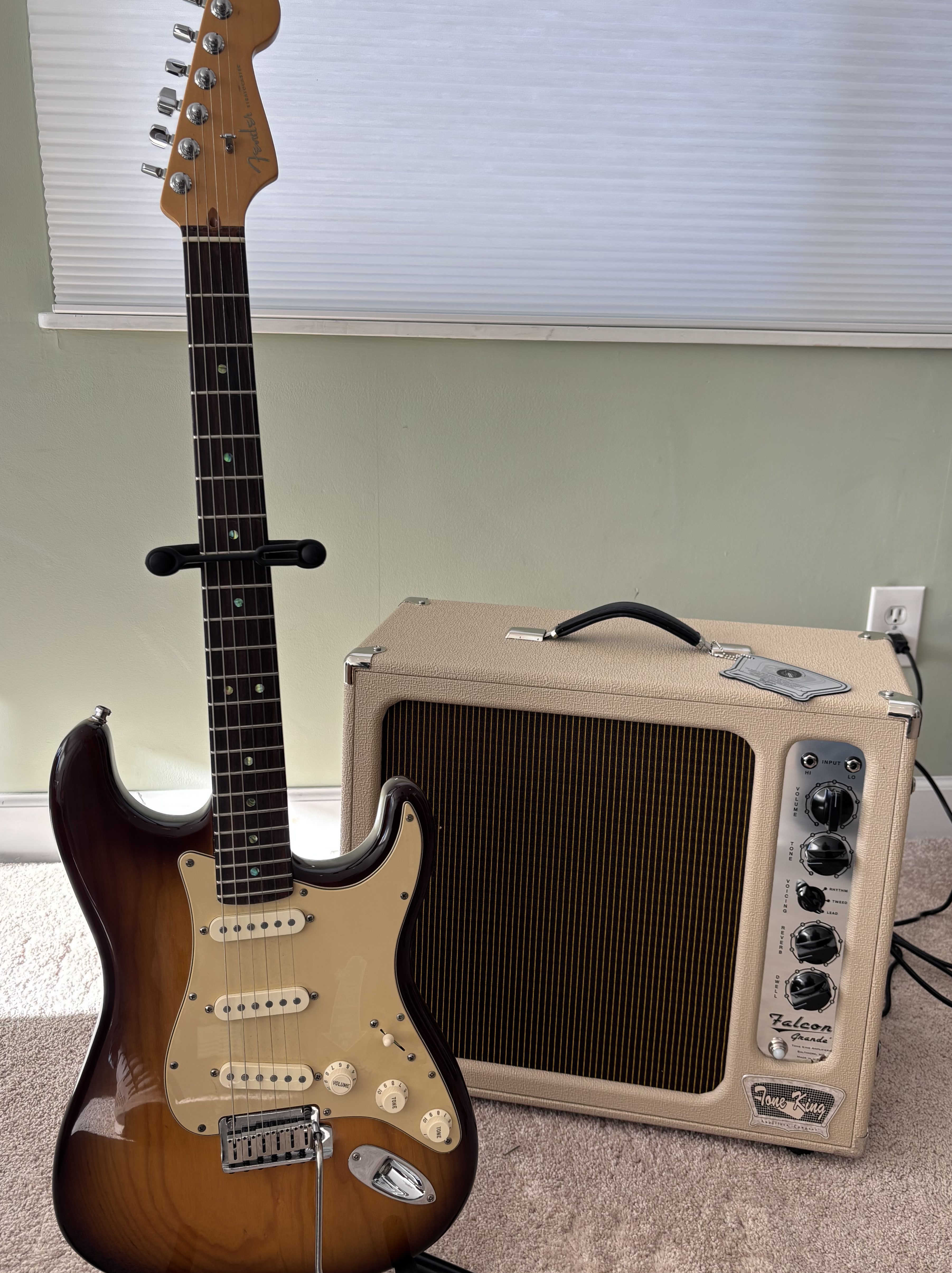
Enter the subject of this long-winded gear review: the Tone King Falcon Grande combo amplifier. I was intrigued by Tone King because their name routinely showed up on Reddit threads about tube amps that are well-suited to achieving rock tones at low volume. That makes sense since Tone King is well-known for their Ironman attenuators. Plus, the company started off just down the road from me in Baltimore, Maryland.
After trying some Tone King products in a local guitar store, I purchased a Tone King Falcon Grande. Although the amp did many things well, I ultimately returned it.
Falcon Grande Pros:
- The Tone King Falcon Grande comes with three different voice settings. All three are a ton of fun. I loved plugging directly into the amp and switching from clean to overdriven with just the included foot switch.
- The tweed setting captured 1950s blues sounds very nicely. It could also get a great Chuck Berry sound.
- The lead channel worked well for blues-rock (it reminded me of ZZ Top and the Black Keys).
- It’s an expressive sounding amp.
- It records very nicely at low volumes.
- Stunning aesthetics—particularly the all-cream cabinet.
- The built-in attenuator reduced volume without messing up the tone.
- Simplicity of knobs and control.
Falcon Grande Cons:
- Attenuator could be more flexible:
- The built-in attenuator is not continuous. Instead it has a handful of fixed settings. That made the lead channel difficult to use at home. At the most-attenuated setting it was too quiet for anything other than recording. For example, a backing track would drown it out. Conversely, the second-most attenuated setting was a little bit too loud. I kept wishing for an additional notch on the attenuator. Sure, you could turn the volume down separately from the attenuator, but that also decreases the gain. All this left the Falcon Grande’s most rocking tones tantalizingly out of reach, at least in my relatively small room. To be fair, this was not an issue for the other two voices. And if you have a large space it might not be a problem for you.
- Rattle and buzz:
- The amp rattled and buzzed at medium to high volumes. Unfortunately, these noises were loud enough to be heard over the sound of the guitar. My wife could hear it too. Based on some experimenting it seems like the buzz was coming mainly from the control panel and from the tube area in the back. The front panel in particular seemed to buzz like a kazoo.
- Some have speculated online that the buzz/rattle is because the Falcon Grande is fairly bass heavy and the single tone knob doesn’t leave a lot of flexibility for dialing that out.
- Notably, the rattle and buzz occurred even with some of Tone King’s suggested tone settings.
In the end, although the amp did a lot of what I hoped it would, I just couldn’t stomach the boutique amp price for a product that buzzed and rattled more than my mass-produced Hot Rod Deluxe. That said, if you were only going to use the amp at low volumes I think it would work very well (although you might be better off with the lower-watt Tone King Gremlin).
 DIY Rock and Roll