Or, My Adventure Hitting the Waves with a 1966 Fender Coronado II
Memorial Day is in the rear-view mirror and the hottest days of summer are rapidly approaching. It seems like the perfect time to try my hand at one of the most quintessentially summer of all of rock’s sub-genres. That’s right: hang ten and shoot the curl, because surf’s up on DIYRockAndRoll.com!
A brief, incomplete, and occasionally subjective history of surf
I’m probably not alone in associating surf rock with summer fun and sun-drenched, teen nostalgia. Put on Point Panic or Tidal Wave, and it’s easy to imagine cruising the PCH with the roar of Pacific breakers mixing with the wind in your Thunderbird convertible. Maybe you’re on your way to a technicolor beach party spectacular with Annette Funicello and Frankie Avalon. Or… you could put on Dick Dale’s Miserlou or A Run For Life and almost feel a 50-foot wave bearing down on you.
Surf rock is also a fitting way to kick off our adventures in do-it-yourself rocking because it takes us close to the dawn of rock and roll. Although surf is not the genesis of rock, it’s surely one of the first permutations of what was still a fledgling genre when the early surf records were released.
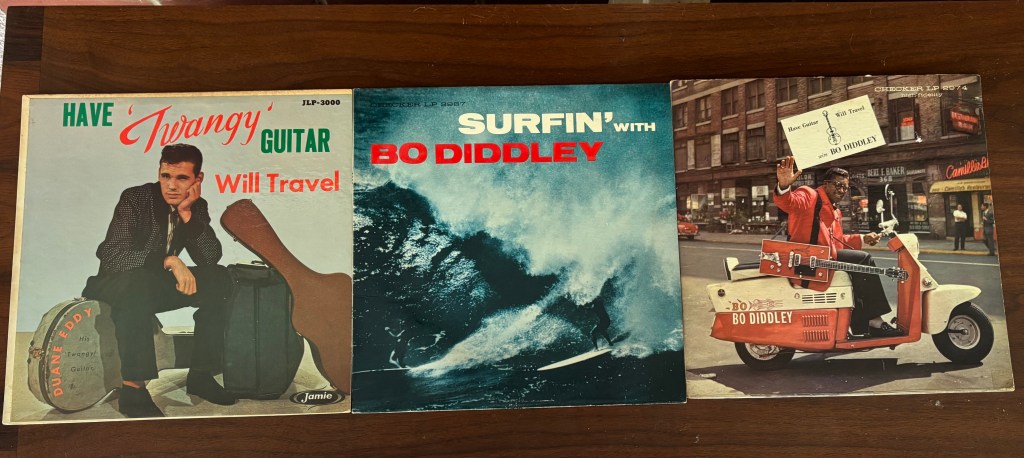
Surf rock has obvious antecedents/relatives in 1950s and early 1960s guitar instrumentals like Bill Justis’s Raunchy, Link Wray’s Rumble, Sandy Nelson’s Teen Beat, the Shadows’ Apache, Chuck Berry’s Blues for Hawaiians, Duane Eddy’s Rebel Rouser, and a bunch of bizarre and awesome Bo Diddley instrumentals like Mumblin’ Guitar and Spanish Guitar. (Bo’s record label would infamously cash in on the surf craze with a thematic album packed in part with filler actually recorded by someone else).
As with seemingly all things involving the origins of rock and roll—there’s some ambiguity about surf rock’s big bang. In his phenomenal liner notes for Cowabunga! The Surf Box, surf music expert John Blair writes that Dick Dale’s 1961 hit Let’s Go Trippin is “[c]onsidered to be the first distinguishable surf music record.”
That certainly sounds surfy to me, although Blair also identifies several songs from 1960 like Church Key by the Revels, which he describes as “surf music prototypes.” For what it’s worth, in his essay for Cowabunga!, Dick Dale said that surf rock predates its earliest recordings and was being played live as early as the mid-1950s.
If the precise birthday is uncertain, surf rock’s place of birth seems easier to pin down. Key surf figures like Dale, the Chantays, and the Surfaris came out of Southern California, where surf rock developed alongside surfing culture, teen dances, and recording studios. But the geographical purity of surf rock has always been a bit muddled by contributions from bands like the Trashmen out of Minneapolis (Surfin’ Bird) and the Astronauts from Colorado (Baja)—both pretty far from the pacific paradise their music evoked. Not to mention, I personally find it hard to think of surf rock without thinking of the Ventures, who were actually from Tacoma, Washington (the Ventures started recording in the 1950s, although they would later record surfy classics like Diamond Head).
Regardless of the exact details, Blair explains that surf rock found its way into the top 100 roughly 30 times starting in September of 1961, with big years in ’62 and ‘63. Then, almost as fast as it began, the genre’s commercial power faded. The Pyramids recorded what the Allmusic Guide has called “the last big national instrumental surf hit” with Penetration in 1964. Surf rock would soon be overshadowed by the British invasion, folk rock, psychedelia, and the loud forerunners of hard rock. (Although does anything actually-rock harder than Dick Dale, a true progenitor of guitar shredding?). Even the Beach Boys–the leading purveyor of vocal tunes with surf themes–would leave their lyrics about cars, girls, and waves behind for more adventurous lyrical content and arrangements (see, e.g., “Pet Sounds”). (I am not going to weigh in on the debate about whether The Beach Boys and Jan & Dean are surf rock or just rock/pop about surfing; but that topic is explored in Cowabunga!).
When the tide of surf rock receded, it left an interesting legacy for musical beach combers. For one thing, there are the band names—a fabulous menagerie of monikers styled as “the [Plural Knowns]” … like the Frog Men, the Surf Men, the Honeys, the Tornadoes, the Lively Ones, the Centurions, the Blazers, the Surfaris, the Astronauts, and the Pyramids. It also left behind a body of classic recordings that continues to inspire contemporary artists and that can turn even a rainy winter day in New England into a summer stroll down Doheny Beach. But the most relevant legacy for the DIY rock and roller is that surf rock was something of a proving ground for musicians who went on to other things. For example, Blair writes that the surf group the Sentinals launched the career of drummer Johnny Barbata, who would go on to play with the Turtles, CSNY, and Jefferson Starship. As another illustration, in his fascinating autobiography Born to Run, Bruce Springsteen describes one of his early band’s attempts to play Wipeout. He wrote that the song was an essential part of the repertoire in the New Jersey garage scene (a problem since his drummer apparently couldn’t nail the beat). And to really see how big a role surf rock played as a laboratory for other forms of rock waiting in the wings, just check out this recording of Canadian surf rock group the Squires, featuring Neil Young at the dawn of his storied career:
My Surf Rock Experiment:
The Composition
As a surf rock fan, I’d written some little surf rock riffs, jammed along in my room with surf backing tracks, and even did a quick demo arrangement of Blue Moon as a mid-tempo surf tune. But I’d never composed and recorded an entire surf rock song. For this project I decided to rework an acoustic instrumental I wrote, entitled Telluride, which was inspired by a hiking trip in Colorado. My demo recording of that is just finger-picking on a Martin D-28 and sounds more Americana than surf. But I thought the main figure of the song, a B7 chord shape walked down from the 7th fret to an E chord would lend itself nicely to surf. It’s a little ragged, but here it is if you want to see where this started:
With the shortcut of reworking an existing song of mine, the next decision was: vocals or no vocals? Based on some humorous commentary in the Cowabunga! box set—which I will leave for your discovery—it seems that Dick Dale was probably not a fan of vocal surf tunes by the likes of the Beach Boys and Jan & Dean. I love the Beach Boys and can enjoy some Jan & Dean, but an honest assessment of my baritone vocals ruled out trying to do multi-part harmonies myself. Plus, last time I recorded something where I harmonized with myself, my wife almost peed her pants laughing. Instrumental it is for this one…
A lot of surf rock songs actually have more than just guitars, drums, and bass. The surf rock repertoire features a surprising amount of keyboards and saxophone (the honking sax solo was a dominant sound of 1950s rock and I assume that carried over into surf). I decided to spice up my composition with some reverb-drenched whistling, which was inspired by the Ventures’ whistles in Diamond Head. Although I had decided against lyrics, I thought it would be fun to add a vocal tagline like in Wipeout, Point Panic, or even the non-surf instrumental classic Tequila. Originally, I planned to have the instruments drop out and to chant “Telluride” since it was the name of my original recording. But by the time I was done adding all the guitar, bass, and whistling the song sounded far more like spy movie music than the surfy mix of the Ventures and Sergio Leone that I originally envisioned. After trying some different phrases that didn’t work, my wife suggested naming the song after the 1966 Fender Coronado II featured prominently on the song. Hence, Coronado. Here it is, in all it’s lo-fi glory:
The Gear
I think the gold standard for surf rock tone is Dick Dale. Unfortunately, Dale said: “If you’re not playing a Fender Stratocaster guitar with 16, 18, 18, 38, 48, and 58/60 thousandths-gauge strings, and projected out of a vintage Fender transformer blowing through twin vintage 15-inch JBL-D130F speakers placed in a three-foot tall, two-foot wide, one-foot deep cabinet packed full with fiberglass with no portholes, you can’t duplicate the true, original ‘Dick Dale surf sound.’”
Well darn. Other than the Stratocaster, that definitely ruled out anything approaching a purist approach to my gear for this song. Instead, I tried to approximate an amalgam of 1960s surf rock sounds.
Guitars, Amps, and Pedals:
When I think of surf rock guitar tone, I think of shimmering, bell-like clean tones. Although Cowabunga! has a picture of at least one surf band using a Gibson with humbuckers, I think this is a domain where single coil pickups are particularly well suited. I also imagine plenty of reverb and delay.
So, for the rhythm guitar I used my Fender Stratocaster, which is an American Deluxe Ash from the early 2000s. I suspect I’ll have plenty more to say about this guitar in future installments, since it’s a fave. It’s also the only guitar I own with a whammy bar, which is a must to get that classic vibrato sound on sustained chords. I used the bridge-minus-one setting (in between bridge and middle) because I thought it would cut through nicely without too much harshness. I played it into a Fender Hot Rod Deluxe (Texas Red) amp of a similar vintage, which was set pretty clean with plenty of reverb. I do typically use an attenuator with that amp to keep it from shattering my ear drums and the windows (a topic for another day). I think the only pedal I used was an MXR Carbon Copy Mini for some delay to draw out the splashy atmosphere a bit more.
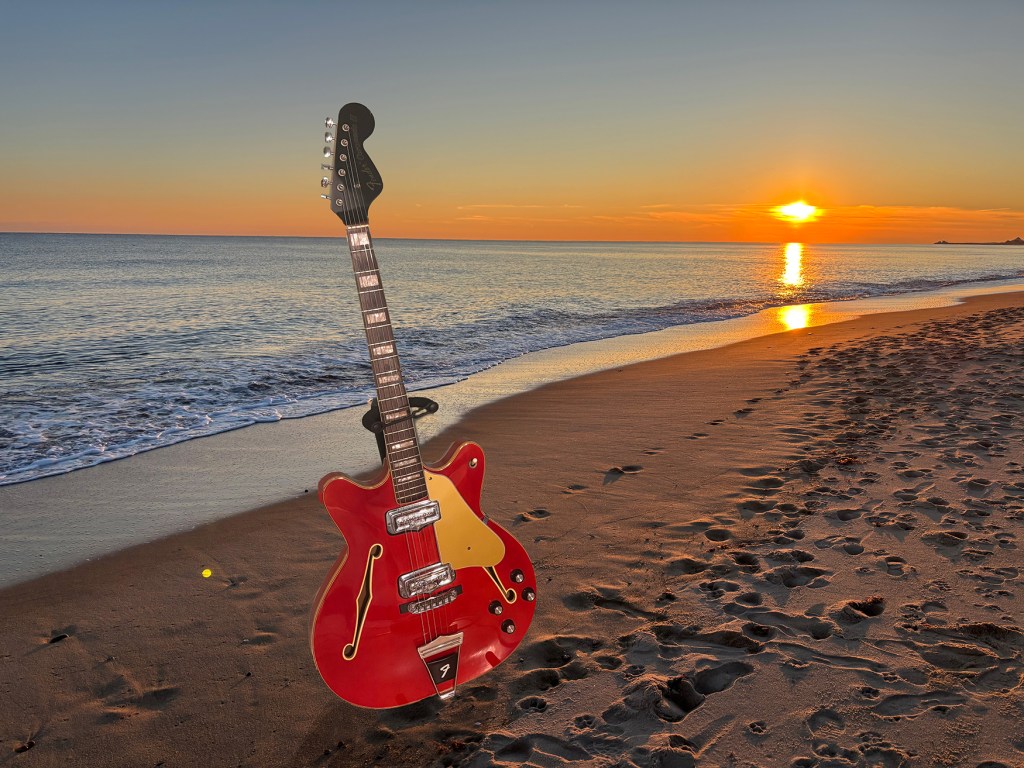
Lead guitar: To give my recording some authentically vintage tones, I thought it would be fun to use a vintage instrument. I only own one vintage electric guitar (yet, mwahaha!): a 1966 Fender Coronado II with DeArmond pickups. I haven’t owned this guitar for long and I’m still getting used to it, but the neck pickup has an enormous, thick tone. To my ears, it almost sounds like a baritone guitar. I used the neck pickup throughout the song and varied the tone by either palm-muting or picking closer to the bridge for the twangy spy riff in the third verse. I think the Coronado would be perfect for surf rock if only it had a whammy bar (some of them do; mine does not). To compensate, I ran the Coronado through a Boss TR-2 Tremolo pedal. Although that type of tremolo makes me think of Creedence Clearwater Revival and Pops Staples more than surf rock, I thought the effect on the Coronado sounded cool. I also added some delay through the MXR Carbon Copy Mini. To try and give the impression of a band with different guitars and amps, I plugged the Coronado into a Carr Super Bee. That amp is a topic for another post as well, but the gist is that it’s Carr’s boutique take on a Fender Super Reverb with the benefit of a built-in attenuator. The Super Bee is sort of three amps in one, as it has a switch to go between three modes: 1964, 1968, and 1972 (with the ’72 setting voiced for the most gain, and the ’64 the least). Although the ’64 setting would have probably been the obvious choice conceptually, I thought the ’68 was particularly well suited to the Coronado and gave a bit more contrast from the Hot Rod Deluxe.
Bass:
I enjoy playing bass, but I am not a bass player. I used the only bass I own; a Dean electric with a single pickup, which was purchased used over a decade ago and may still have the original strings. It’s been more than enough for my limited skill set on the instrument and it holds its tune surprisingly well. But I suspect it was not designed with surf rock in mind. Based on the stickers affixed to it when I bought it, I assume its original owner was more of a metal head. For this recording, I decided to avoid the headaches of recording a bass amplifier and instead used one of Garageband’s amp simulators (fittingly titled “60’s Combo”). To tighten up the sound a little bit I ran the bass through a Warm Audio Centavo Centaur (a Klon Clone).
Vocals, Such That They Are:
I wanted to have some kind of retro sounding effect when I shouted “Coronado!” I decided to add a ton of delay and tremolo by running my vocal mic through the Boss TR-2 Tremolo Pedal and MXR Carbon Copy Mini. Then I added reverb and atmosphere in Garageband, and tripled the vocals. The result is a campy, underwater sound (or, according to my wife, I sound like a ghost).
“Drums:”
I think drums and percussion are the single, biggest challenge for the DIY rock and roller. I don’t play drums, and my wife who has been incredibly understanding of my burgeoning collection of guitars has drawn the line at adding a drum set. She’ll let me pretend to be Chuck Berry, but Gene Krupa is apparently a bridge too far. Fortunately, for anyone in a similar position, there’s a fun workaround courtesy of Steve’s Surf and Rockabilly, which offers a package of royalty-free surf and rockabilly drum samples and patterns that you can piece together to create your own surf rock drummer. I combined a variety of their samples, fills, and accents to create a drum track (or really tracks) in garageband that matched the rhythm and tempo for how I envisioned a surf version of Telluride sounding. I will draw on these samples again since they sound great and are easy to use, although I plan to experiment with other percussion workarounds in the future (particularly if I’m recording outside the surf/rockabilly context).
Recording Gear:
Sure SM57 (for amps); Sure SM58 (for “vocals”); Focusrite Scarlett 4i4; Garageband.
Naming my “Band”
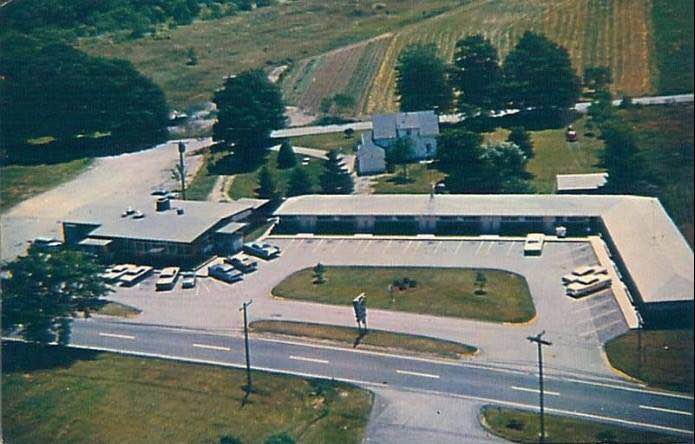
The final step in my DIY rock and roll adventure was naming my fictional band. In honor of the surf rock naming convention that requires use of a plural noun, I went with Pete Berris & the Motor Inns. For those unfamiliar with the term “Motor Inn,” it’s a motel and restaurant common to roadside America in the middle of the last century. My grandparents operated a Motor Inn called the Berris Motor Inn in rural Connecticut, so I figured the name would be an insider-pun and also would capture a nostalgic, Americana vibe appropriate for surf rock.
Suggested Listening to Keep Those Waves Coming All Summer Long!

Looking for some non-DIY surf rock as a soundtrack for your summer? If you can’t tell from the copious references above, I really don’t think you could ask for a better starting place than Cowabunga! The Surf Box from Rhino. It was an invaluable resource for this project. Although it’s out of print, you can still find gently used copies online. It offers a phenomenal survey of classic and newer surf rock across four CDs. And the packaging is topnotch. The paperback booklet is a fascinating and entertaining read and Rhino even included fake water droplets on the surfboard-inspired box. A cheaper option is Rhino’s one-CD compilation entitled Guitar Player Presents: Legends of Guitar: Surf, Vol. 1. It doesn’t have the breadth and depth of Cowabunga!, but it’s a crash course of surf classics. Also out of print, but I saw some copies available used on Discogs.
The reissue label Sundazed has an overwhelming amount of surf music available on vinyl. I’ve really enjoyed their 2023 compilation entitled Surfin’ the Great Lakes: Kay Bank Studio Surf Sides of the 1960s. The lovingly produced collection is fun from start to finish. It also gives some long overdue context and attention to surf bands from the Midwest. I’m pleased to report that there’s far more to midwest surf than just Surfin’ Bird!
Finally, if you want some new surf rock, I highly recommend checking out some of the recent releases by Marty Stuart and his Fabulous Superlatives. For Record Store Day 2025, they released a new instrumental album called “Space Junk,” which takes on the surf tradition with aplomb. It’s a little tricky to find since it was a limited edition release, but Marty and his band also included surfy instrumentals on their previous albums Way Out West and Altitude. Or, better yet, catch them live and watch them effortlessly transition between surf rock, rockabilly, classic country, country rock, and bluegrass. Their live surf performances are so convincing you’d almost believe the genre was invented on a Telecaster near Nashville instead of a Stratocaster near the Pacific Ocean.
Conclusion
Surf rock may just be the ultimate DIY rock genre. Its relative structural simplicity and emphasis on instrumentals provides an accessible starting point. Many of the genre’s greatest tunes exude a DIY energy and homespun creativity. I hope that this post provides you with some inspiration, source material, and ideas to make your own surf rock tunes. Remember: don’t let the perfect be the enemy of the good enough for rock and roll!
 DIY Rock and Roll
Pingback: Do it Yourself Jump Blues/Boogie Woogie/1940s R&B | DIY Rock and Roll
Pingback: Do it Yourself Blues Rock | DIY Rock and Roll
Pingback: 1966 Fender Coronado II: A Profile and a Review | DIY Rock and Roll
Pingback: Do It Yourself Rockabilly | DIY Rock and Roll
Pingback: Dick Dale Belongs in the Rock and Roll Hall of Fame | DIY Rock and Roll